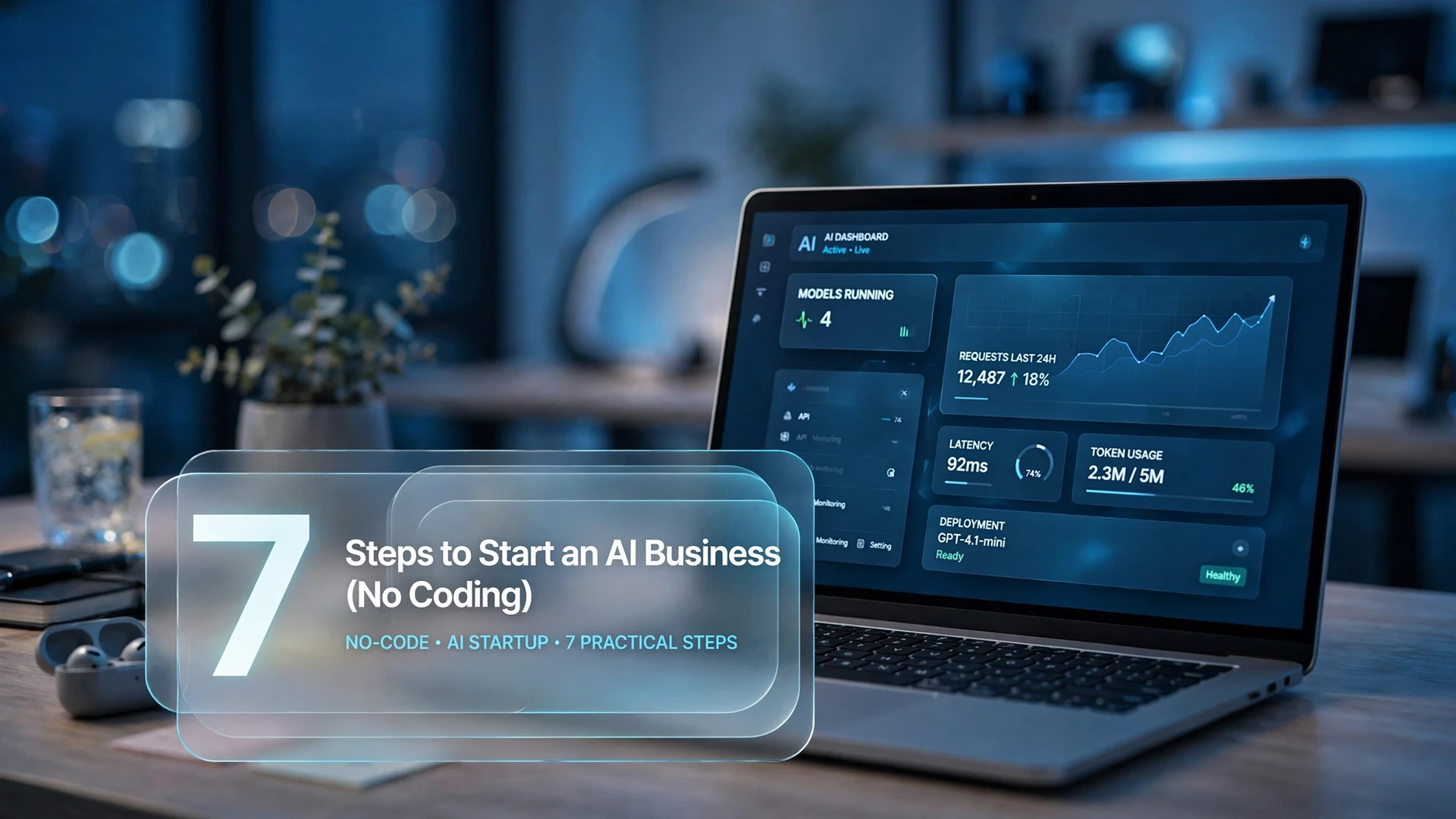
If you want to start an AI business but have zero coding skills, here is the good news: you do not need to write a single line of code. Thanks to powerful no-code AI tools, beginners in the US are launching profitable AI service businesses from their laptops — offering services like AI-powered content writing, chatbots, automation, and design to small businesses. This guide walks you through the exact 7 steps to get your AI business up and running, even if you are starting from scratch.
The best part? You can begin this weekend with nothing more than a laptop, an internet connection, and a willingness to learn. Let us break down each step so you can take action right away.
1. Pick a Profitable AI Service Niche
The first and most important step when you start an AI business is choosing the right niche. Businesses do not pay for “AI” in general — they pay for specific problems solved. Think about services small businesses already buy, then imagine delivering them faster and cheaper with AI tools: blog writing, social media content, product descriptions, email newsletters, customer service chatbots, and workflow automation.
Pick one niche where you already have some interest or knowledge. If you love writing, offer AI-assisted blog content. If you enjoy tech, offer AI chatbot setup for local businesses. A focused niche makes marketing easier and lets you charge premium prices because you look like a specialist, not a generalist. Research what competitors charge on Upwork and Fiverr to confirm there is real demand before you commit.

2. Choose Your No-Code AI Tools
Your AI business runs on tools, so pick a small stack of reliable no-code platforms and master them. Start with a flagship AI model like ChatGPT or Claude for content and strategy, an image tool like Midjourney or Canva’s AI features for visuals, and an automation platform like Zapier or Make for connecting apps and workflows.
You do not need every tool on the market — three to five well-learned tools beat twenty half-learned ones. Most of these offer free tiers or trials, so you can practice without spending a dime. Set aside a week to learn each tool deeply: watch tutorials, complete sample projects, and learn prompt engineering, because better prompts mean better deliverables and happier clients.

3. Build a Portfolio of Sample Work
Clients buy results, and a portfolio proves you can deliver. Before chasing paying customers, create 5 to 10 sample projects in your niche using your AI tools. If your niche is AI content writing, write sample blog posts for fictional businesses. If it is chatbots, build a demo chatbot for a mock restaurant or dental clinic.
Package these samples into a simple portfolio website or even a clean Google Drive folder with a professional one-page overview. Add mock case studies showing the before-and-after: “This sample email sequence was created in 2 hours using AI workflows.” Real-looking samples turn skeptical prospects into paying clients, so invest real effort here — this portfolio does your selling for you.

4. Set Up Your Business Basics
Once your skills and samples are ready, handle the business fundamentals. Choose a business name, register as a sole proprietor or LLC (an LLC is popular in the US for liability protection and costs roughly $50 to $300 depending on your state), and get any local business licenses your city requires. Open a separate bank account to keep business income clean from day one.
Then build your online presence: a simple one-page website with your services, portfolio, and a contact form, plus professional profiles on LinkedIn and one freelancing platform like Upwork. Add a basic contract template covering scope, payment terms, and revisions — you can adapt free templates online. These basics take a weekend to set up and make you look like a legitimate business from the very first client conversation.

5. Price Your Services for Profit
Pricing trips up most beginners, so keep it simple: start with project-based pricing, not hourly. Clients care about outcomes, and project pricing lets your AI-powered speed become pure profit. A blog post package at $150 each or a chatbot setup at $500 to $1,500 are realistic starting points for US small businesses.
Create three tiers — basic, standard, and premium — to give clients clear choices and nudge most toward the middle option. As your portfolio and testimonials grow, raise your prices every few months. Never compete on being the cheapest; compete on speed, quality, and reliability. A simple rule: if every prospect says yes without negotiating, your prices are too low.

6. Find Your First Paying Clients
Your first clients are closer than you think. Start with warm outreach: message friends, former coworkers, and local business owners, offering a free or discounted pilot project in exchange for a testimonial. Local businesses — dentists, realtors, gyms, restaurants — are goldmines because they need marketing help and rarely get pitched AI services.
Next, list your services on Upwork, Fiverr, and Contra with a niche-specific profile and portfolio samples. Simultaneously, post helpful AI tips on LinkedIn and in Facebook groups where small business owners hang out; consistent, useful content builds trust and inbound leads. Aim for your first 3 paying clients within 30 days — even small projects build the testimonials and confidence that fuel everything after.

7. Scale With Systems and Automation
Once clients are coming in, the difference between a freelancer and a business owner is systems. Document your workflows: create prompt templates, checklists, and standard operating procedures for every service you deliver. This cuts delivery time, keeps quality consistent, and lets you eventually hand work to a virtual assistant.
Then automate your own operations — use AI and tools like Zapier to handle lead follow-ups, invoicing, onboarding emails, and social media scheduling. Reinvest early profits into better tools and marketing. With systems in place, you can take on more clients without working more hours, raise prices with confidence, and turn your no-code AI business into a genuine income asset.

Frequently Asked Questions
Can I really start an AI business with no coding skills?
Yes. Modern no-code AI platforms like ChatGPT, Claude, Zapier, and Canva let you build real client services — content, chatbots, automation, design — through simple interfaces and prompts. Your value is in knowing how to combine these tools to solve business problems, not in writing code.
How much money do I need to start an AI business?
You can start with under $100. Most AI tools have free tiers, a basic website costs $10 to $20 per year for a domain, and LLC registration runs $50 to $300 depending on your state. Your biggest investment is time spent learning the tools and building a portfolio.
How long does it take to get the first client?
Most beginners land their first paying client within 2 to 6 weeks of consistent outreach. Offering a free or discounted pilot project to a local business in exchange for a testimonial is the fastest path — it removes risk for the client and gives you proof of work.
What is the most profitable AI service for beginners?
AI-powered content writing and social media management are the easiest entry points because every business needs content. AI chatbot setup and workflow automation typically command higher fees ($500 to $2,000+ per project) once you have a few case studies.
Do I need an LLC to start an AI business?
Not immediately — you can start as a sole proprietor. But forming an LLC is smart once you have paying clients, as it separates your personal assets from business liability. It is inexpensive and can usually be done online in under an hour.
How do I compete with other AI service providers?
Specialize. A provider who does “everything AI” competes with everyone; a provider who builds “AI chatbots for dental clinics” competes with almost no one. Combine a tight niche with fast turnaround and great communication, and you will stand out without racing to the bottom on price.
Conclusion
Starting an AI business with no coding is one of the most accessible opportunities available to beginners right now. Pick a profitable niche, master a small set of no-code tools, build a portfolio that proves your skills, set up your business basics, price for profit, land your first clients through warm outreach, and scale with systems. Follow these 7 steps, take action this week, and you could have your first paying client within a month. The AI wave is here — the only question is whether you will ride it.