Notion’s 100-million-user community has created a thriving marketplace for templates — and unlike printables, Notion templates command premium prices because buyers see them as systems, not documents. These 11 Notion template ideas target buyers with real workflows to organize, from freelancers to real estate investors, each with a clear reason someone would pay instead of building it themselves.
1. Freelance Client CRM and Invoice Tracker
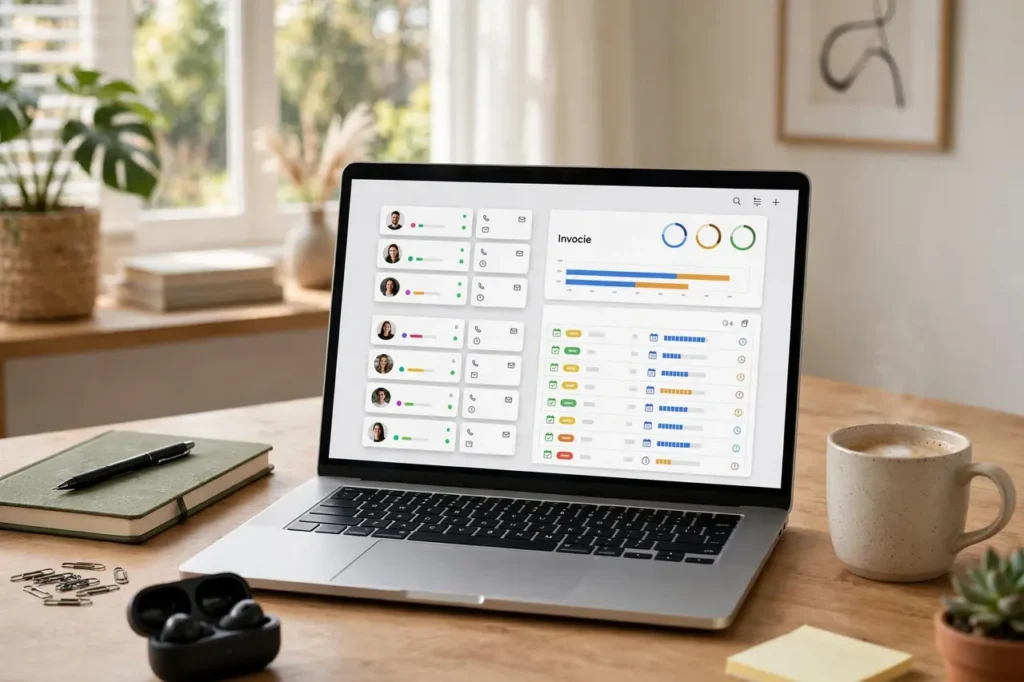
Freelancers lose money to disorganization — forgotten follow-ups, late invoices, scattered client notes. A Notion CRM with linked databases for clients, projects, invoices, and payment status gives solo freelancers an agency-grade system without agency software costs.
This is one of the best-selling Notion template categories because the buyer is a business owner with revenue — they’ll pay $29 to $79 to fix a problem that costs them clients. Include proposal templates and onboarding checklists to justify the premium price.
2. YouTube Content Pipeline Dashboard

Serious YouTubers manage ideation, scripting, filming, editing, thumbnails, and publishing across dozens of videos — usually in chaotic spreadsheets. A pipeline dashboard with kanban views per production stage, content calendar, and analytics log turns content chaos into a real operation.
Target channels with 10k+ subscribers who treat YouTube as a business; they have both the pain and the budget. Add sponsorship trackers and affiliate link databases to make it the operating system for their channel.
3. Personal Net Worth and Budget Dashboard

Budget apps charge monthly fees and sell user data — a Notion net worth dashboard with account tracking, monthly budget database, and automated net worth charts appeals to the financially-savvy crowd that wants ownership of their data. Finance templates consistently rank among Gumroad’s top sellers.
Design it with a clean, premium aesthetic and include video setup instructions; finance buyers pay for polish and clarity. This template also works as a lead magnet for financial coaching upsells.
4. Student Assignment and Exam Planner

Students juggle syllabi, deadlines, and exam dates across five classes — most with nothing but phone reminders. An academic planner with course databases, assignment trackers with priority views, exam countdown widgets, and GPA calculators is purpose-built for how students actually work.
Back-to-school season (August/September and January) creates massive predictable demand spikes. Market through study-focused TikTok and YouTube creators, and offer a free lite version to drive paid upgrades.
5. Real Estate Deal Analyzer for Investors

Real estate investors evaluate dozens of deals to buy one — comparing cap rates, cash-on-cash returns, and rehab costs across properties. A Notion deal analyzer with property databases, built-in investment formulas, and side-by-side comparison views replaces the fragile spreadsheets most investors hate.
Investors are high-intent buyers: a template that helps evaluate a six-figure purchase is an easy $49 to $99 sale. Real estate investing communities and BiggerPockets-style forums are full of your exact customers.
6. Small Business Inventory Manager

Etsy sellers, resellers, and small retailers track inventory in notebooks and spreadsheets until stockouts cost them real sales. A Notion inventory system with product databases, stock-level alerts, supplier contacts, and reorder views gives small businesses enterprise-lite organization.
Bundle it with order tracking and profit calculators for a complete “small business OS.” Your buyers already sell online, so they understand digital products and convert at high rates.
7. Book Manuscript Organizer for Authors

Authors drafting books drown in scattered drafts, research notes, and character sheets across a dozen apps. A manuscript organizer with chapter databases, character bibles, research libraries, and writing-progress trackers gives writers one home for the entire book project.
Self-publishing communities (KDP authors, NaNoWriMo participants) are passionate and recommendation-driven — one viral mention in an author group can drive hundreds of sales. Include publishing checklists to extend the template’s value past “the end.”
8. SaaS Startup KPI and Metrics Dashboard

Early-stage founders track MRR, churn, CAC, and runway in messy spreadsheets they’ll outgrow in months. A founder-grade KPI dashboard with metrics databases, investor-update generators, and goal tracking gives startups boardroom-ready reporting from day one.
Founders are premium buyers — price at $79 to $149 without blinking. Startup accelerators, indie hacker communities, and founder Twitter are direct channels to buyers with both budget and urgency.
9. Language Learning Vocabulary System

Language learners collect vocabulary in apps that never connect to their actual study routine. A Notion system with spaced-repetition scheduling, grammar rule databases, immersion logs, and proficiency trackers turns casual Duolingo users into structured learners.
Language learning is a lifelong pursuit with deeply engaged communities for every major language — create Spanish, French, and Japanese variants to triple your market. Polyglot YouTubers are enthusiastic affiliates.
10. Home Renovation Project Planner

Renovations spiral over budget when homeowners track quotes, contractors, and timelines in text threads. A renovation planner with contractor comparison databases, budget-vs-actual tracking, timeline views, and decision logs brings project management discipline to the most expensive project most people ever run.
Homeowners mid-renovation are stressed, time-pressed, and spending thousands — a $39 template that prevents one costly mistake pays for itself instantly. Home improvement Pinterest and renovation forums are natural hunting grounds.
11. Nonprofit Donor Management System

Small nonprofits can’t afford Salesforce but still need to track donors, grants, volunteers, and fundraising campaigns. A donor management system with contact databases, donation histories, grant deadline trackers, and campaign views gives tiny nonprofits enterprise-style organization at a fraction of the cost.
This is a blue-ocean niche with almost no template competition and buyers who purchase organizationally (expense it, don’t think twice). Nonprofit professional associations and grant-writing communities are underserved channels worth cultivating.
Frequently Asked Questions
Where can I sell Notion templates?
Gumroad is the most popular platform for Notion templates, with Notion’s own template gallery and Etsy as strong secondary channels. Many top sellers also sell direct from their own websites to keep 100% of revenue after building an audience.
How much do Notion templates sell for?
Simple templates sell for $9 to $29, while comprehensive systems (CRMs, business dashboards, investor tools) command $49 to $149. Business and finance templates price highest because buyers measure value against revenue, not entertainment.
Do I need to be a Notion expert to sell templates?
You need solid intermediate skills — relational databases, rollups, and filtered views — but not developer-level expertise. Build templates for workflows you personally understand; authenticity in the use case matters more than technical complexity.
How do I prevent buyers from sharing my template link?
Use Gumroad’s license-key delivery or a duplication workflow where buyers submit their email to receive a private duplicate link. Some piracy is inevitable, but most buyers are honest — focus on making the official version (with updates and support) clearly worth paying for.
Conclusion
Notion templates sell best when they’re built for a specific buyer’s workflow — not generic “productivity dashboards” but a real estate investor’s deal analyzer or a YouTuber’s content pipeline. Pick a niche you understand, build the system you’d want yourself, price it against the value it creates, and sell where that audience already shops. One great template can outsell a hundred mediocre ones.