
Not everyone thrives in a chatty, meeting-heavy remote job, and that is not a weakness — it is a working style. Remote jobs with minimal teamwork suit independent workers who do their best thinking alone, prefer written instructions to video calls, and want to be judged on output rather than presence. The roles below share a pattern: you receive a clear task, work on it independently, and deliver a finished result, with little or no daily collaboration. Look for employers that describe their culture as asynchronous or documentation-first, and be honest in interviews that you prefer solo, focused work. If you are switching careers, remote jobs for career changers lists roles that welcome newcomers.
1. Audit Medical Charts Remotely for Billing Accuracy
Medical chart auditors review patient records and billing codes to catch errors before claims are submitted, and the work is almost entirely solo. You compare documentation against coding rules, flag discrepancies, and write up your findings in a report — no team meetings, no client calls, just careful, quiet review. Most roles require some training in medical coding or a related certification, and many employers let you work through a queue of charts at your own pace. If you are detail-oriented and comfortable with healthcare terminology, this is one of the most stable low-interaction remote careers available.

2. Reconcile E-Commerce Accounts for Online Sellers
Online sellers juggle sales across multiple platforms, payment processors, and bank accounts, and they need someone to reconcile it all each month. As a remote reconciler, you match transactions, spot missing payouts and duplicate charges, and deliver a clean monthly summary — working alone with spreadsheets and accounting software. You typically serve one client at a time and communicate by email, which keeps interaction minimal. Basic bookkeeping knowledge is enough to start, and sellers who find a reliable reconciler tend to keep them for years.

3. Proofread Podcast Transcripts on Your Own Schedule
Podcasters and production companies need transcripts proofread for accuracy, and the work is ideal for independent workers: you receive an audio file and a draft transcript, listen carefully, correct errors, and return a clean document. There are no meetings and rarely any calls — instructions arrive by email, and deadlines are usually generous. You need good listening skills, strong grammar, and patience for long audio, but no special equipment beyond headphones. Many proofreaders take on work from several shows at once, choosing only the episodes and schedules that suit them.

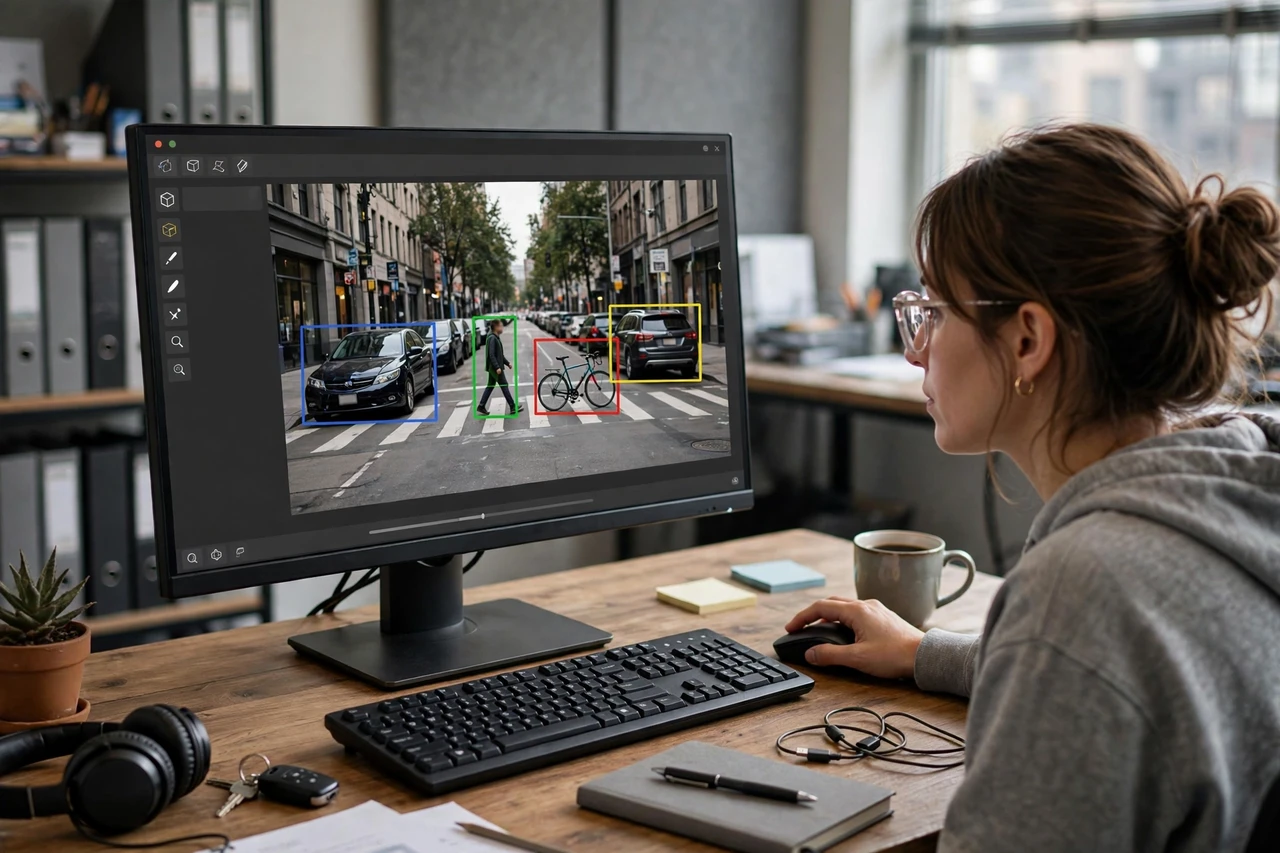
4. Label Images for Self-Driving Car Datasets
Self-driving car companies train their systems on millions of labeled images, and human labelers mark pedestrians, signs, lane lines, and vehicles in each frame. The work is done through a labeling platform, one image at a time, with clear guidelines and quality checks but no team collaboration. It suits people who like repetitive, visual, focused work and can maintain accuracy over long sessions. Pay is usually per task or per hour, and while entry-level labeling is not highly paid, experienced labelers who handle complex scenes can earn more and move into quality review roles.
5. Write Technical Spec Sheets for Hardware Brands
Hardware brands need clear, accurate spec sheets for tools, electronics, and equipment, and technical writers who can work from product documents alone are in demand. You receive manuals, engineering notes, and product samples, then write concise specifications, feature lists, and usage notes that customers and retailers can understand. The work is research-heavy and solitary, with feedback arriving as written comments rather than calls. If you enjoy turning complex details into plain language and prefer a quiet workday, this niche pays well and rarely involves a team.

6. Edit Drone Photos for Land Surveyors
Land surveyors and mapping firms capture huge numbers of drone photos that need sorting, color correction, stitching, and cleanup before they become usable maps and reports. As a remote photo editor in this niche, you work through image batches on your own, following a firm’s style guide and delivering finished files by a set deadline. You need familiarity with photo editing software and a good eye for detail, but no surveying license, since you are handling images rather than measurements. The work is steady, visual, and almost entirely independent, with new batches arriving on a regular schedule.

7. Caption Pre-Recorded Training Videos
Companies produce hours of pre-recorded training videos that need accurate captions for accessibility and for employees who watch without sound. Captioners watch the video, transcribe the speech, sync the text to the timing, and deliver a finished caption file — all solo, all at your own pace. Unlike live captioning, there is no pressure to keep up in real time, and you can pause, rewind, and perfect each line. Training in captioning software helps, but many beginners learn on the job, and the work is a good fit for anyone who likes quiet, precise, screen-based tasks.

8. Research Property Records for Real Estate Investors
Real estate investors need background research before they buy: ownership history, tax records, liens, zoning details, and comparable sales, all pulled from public records. As a remote researcher, you dig through county databases and online records, compile your findings into a clear report, and send it off — no calls, no meetings, just research. You need patience, attention to detail, and comfort navigating government websites, but no real estate license, since you are providing information rather than advice. Investors who trust your reports will send repeat assignments, and the work can grow into a steady freelance practice.

9. Score Standardized Tests Online From Home
Testing companies hire remote scorers to grade essays and open-ended test responses against a detailed rubric, and the work is deliberately solitary: you read responses, apply the scoring guide, and move to the next one, with quality checks built in. Scoring projects run in seasons, often around school testing windows, and you can usually choose shifts that fit your life. A bachelor’s degree is commonly required, and training is provided before each project. If you like focused, judgment-based work without customer interaction, scoring is one of the quietest remote jobs around.

10. Summarize Long Reports Into One-Page Briefs
Busy executives and researchers pay for concise summaries of long reports, studies, and policy documents, and summarizing is a naturally solo skill. You read the full document, identify the key findings and recommendations, and write a clear one-page brief that a busy reader can act on — no meetings, no collaboration, just reading and writing. Clients send documents by email and receive briefs the same way, so your workday stays quiet. Strong reading comprehension and the ability to separate signal from noise matter more than any credential, and a few sample briefs are usually enough to win your first clients.

11. Monitor Prices for E-Commerce Sellers and Report Changes
E-commerce sellers need to know when competitors change prices, run promotions, or go out of stock, and price monitors track those changes and report them in a simple spreadsheet or dashboard. The work involves checking product listings on a set schedule, recording prices accurately, and flagging significant changes — a routine, independent task with no customer contact. You can serve several sellers at once, each with their own product list, and the work scales easily as you build efficient checking routines. It is not glamorous, but it is steady, quiet, and well suited to independent workers who like structured, repeatable tasks.

Frequently Asked Questions
Are remote jobs with minimal teamwork real full-time jobs? Yes. Many of the roles above are full-time positions at companies that work asynchronously, and freelancers can also build a full income from solo assignments. Look for job posts that mention async work, independent tasks, or minimal meetings. For a broader list of legitimate options, see legit remote jobs you can start this week.
Will I still need to attend any meetings? Most solo remote roles include occasional check-ins, such as a weekly email update or a short monthly call. Truly zero-meeting jobs are rare, but the roles above keep meetings to a minimum compared with most remote work.
Do low-interaction remote jobs pay less? Not necessarily. Specialized solo roles like medical chart auditing and technical writing pay well because they require expertise, while entry-level labeling and captioning pay less but offer easier entry. Skill level matters more than sociability.
How do I prove I work well independently? Show a portfolio of finished work, references from past clients or managers, and a track record of meeting deadlines without supervision. In interviews, give specific examples of projects you completed alone from start to finish.
What if I get lonely working alone? That is a real consideration. Many independent workers balance solo work with social time outside work hours, coworking days, or a hobby community. Choose a solo job for your income, and build your social life deliberately around it.