Dividend investing is the most time-tested passive income strategy in existence — shareholders have collected quarterly checks for over a century. These 12 dividend investing tips help beginners build a reliable income stream while avoiding the traps that burn new investors.
1. Start With Dividend Aristocrats
Dividend Aristocrats are S&P 500 companies that have raised dividends for 25+ consecutive years — Johnson & Johnson, Coca-Cola, Procter & Gamble. They’ve increased payouts through recessions, crashes, and pandemics, which is exactly the reliability passive income demands. Start your portfolio here before venturing into higher-yield unknowns.
You don’t need to pick individual Aristocrats; ETFs like NOBL hold them all with instant diversification. It’s the lowest-effort entry point into serious dividend investing.

2. Enroll in DRIP for Compounding
Dividend Reinvestment Plans (DRIP) automatically use your payouts to buy more shares — free, no commissions, often at a discount. A $10,000 investment yielding 4% becomes roughly $14,800 in 10 years with DRIP versus $14,000 taking cash — and the gap explodes over decades. Compounding is the entire game in dividend investing.
Most brokerages offer free synthetic DRIP on any dividend stock. Turn it on from day one; you can always switch to cash payouts later when you actually want the income.

3. Check the Payout Ratio Before Buying
The payout ratio — dividends divided by earnings — tells you whether a dividend is sustainable. Ratios under 60% leave room for growth and safety; ratios over 80% signal the company is stretching, and over 100% means it’s borrowing to pay you. High yield means nothing if the dividend gets cut next quarter.
This single metric filters out most yield traps. A 3% yield with a 40% payout ratio beats a 9% yield with a 95% ratio every time — the first grows, the second collapses.

4. Diversify Across Sectors
Don’t load up on one sector’s dividends — energy, utilities, and REITs all pay well until their sector hits trouble. Spread holdings across consumer staples, healthcare, industrials, financials, and tech so a single industry downturn can’t gut your income. Ten to fifteen positions across five+ sectors is a solid beginner target.
Sector ETFs make this effortless: one dividend ETF often holds 50 to 100 companies across every sector. Diversification is the only free lunch in investing — eat it.

5. Prefer Qualified Dividends for Lower Taxes
Qualified dividends are taxed at 0%, 15%, or 20% depending on income — far below ordinary income rates that hit 37%. Most US company dividends qualify if you hold the stock 60+ days around the payout. This tax edge is a major reason dividends beat bond interest for taxable accounts.
REIT dividends usually don’t qualify (taxed as ordinary income), which is why REITs belong in IRAs while qualified dividend stocks can sit in taxable accounts. Placement matters as much as selection.

6. Buy Before the Ex-Dividend Date
You must own a stock before its ex-dividend date to receive the upcoming payout — buy on or after it, and you wait a full quarter. Brokerages and sites like Nasdaq.com list upcoming ex-dates free; check before placing any dividend buy order. Missing an ex-date by one day costs you three months of income.
Don’t chase ex-dates frantically, though — the stock price typically drops by the dividend amount on the ex-date itself. Use ex-dates for timing, not as a buy signal.

7. Avoid Yield Traps
A 12% dividend yield isn’t a bargain — it’s a warning. Yields spike when stock prices collapse, which usually means the market expects a dividend cut. Before touching any yield above 6%, investigate why it’s high: check the payout ratio, recent earnings trend, and any dividend-cut history. Nine times out of ten, the “deal” is a trap.
The sweet spot for sustainable dividends is 2.5% to 5% yield from profitable, growing companies. Boring and reliable beats exciting and cut.

8. Reinvest During Market Dips
Market selloffs are dividend investors’ Black Friday — quality companies trading 20% cheaper means 20% more yield on new money. The investors who bought Dividend Aristocrats during the 2020 crash locked in yields they’ll collect for decades. Keep a watchlist and deploy cash when fear peaks.
This requires emotional discipline more than skill: automate monthly investments so you buy dips without needing courage. Dollar-cost averaging turns volatility into your employee.

9. Hold Dividends in Tax-Advantaged Accounts
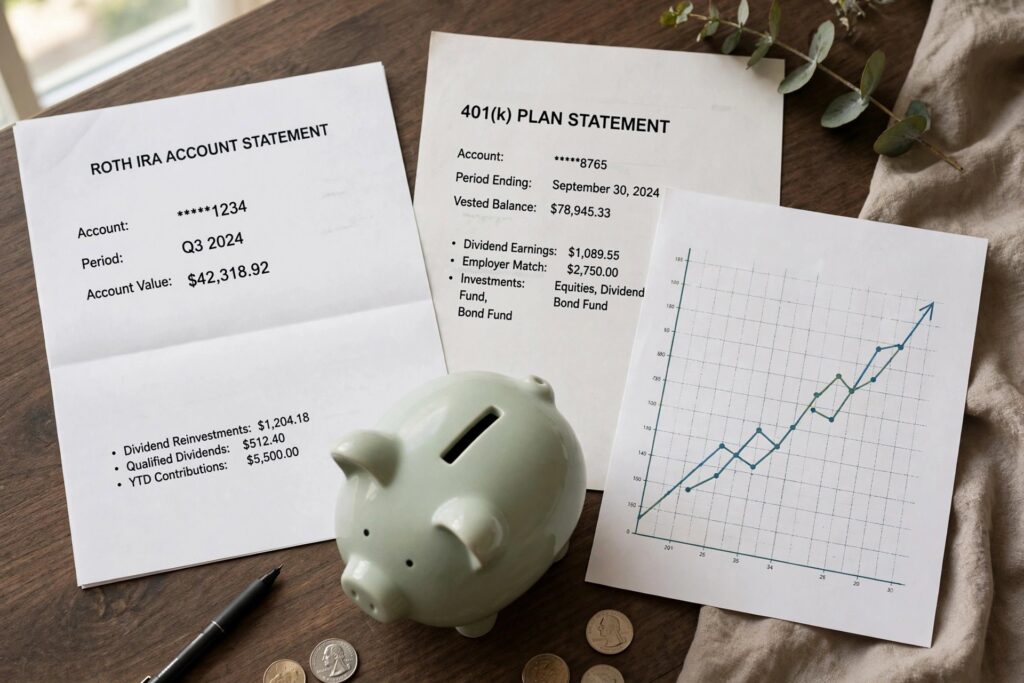
Max out IRA and 401(k) contributions with dividend holdings first — the tax shelter supercharges compounding by eliminating annual tax drag. A Roth IRA is ideal: dividends compound tax-free and withdrawals in retirement are tax-free too. High-yield holdings like REITs especially belong here.
Coordinate across accounts: qualified dividend stocks in taxable (low rates), REITs and high-yield in Roth (sheltered). This asset location strategy can add meaningful percentage points to lifetime returns.
10. Track Payments With a Dividend Calendar
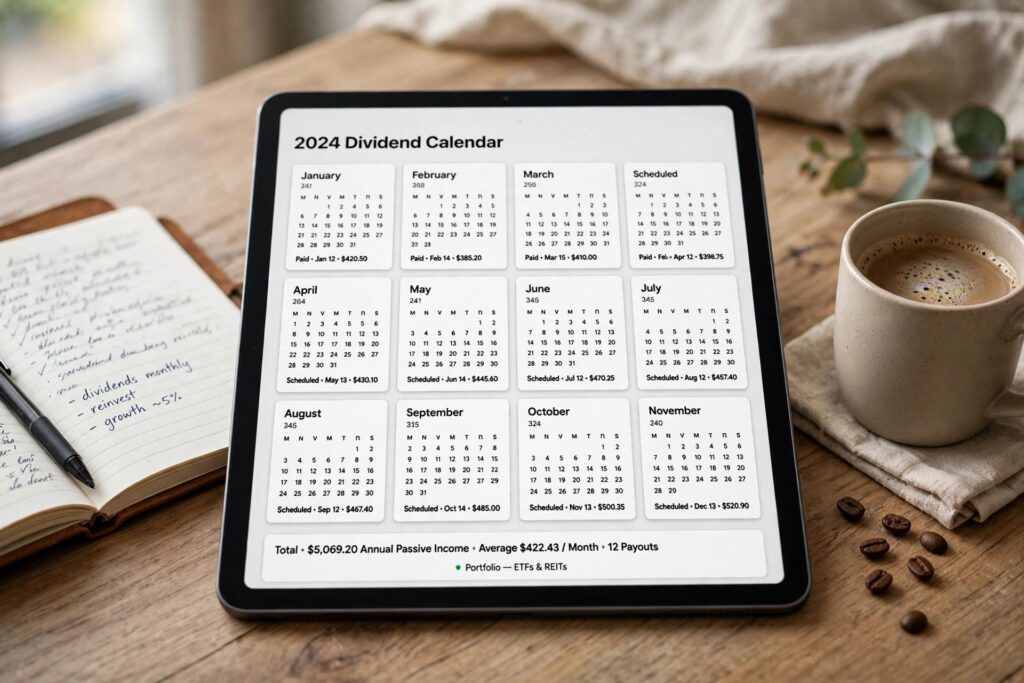
A simple spreadsheet or free tracker (like DivTracker or Snowball) showing expected monthly payouts turns abstract investing into tangible motivation. Watching projected monthly income climb from $12 to $50 to $200 keeps you investing through boring stretches. Most dividend stocks pay quarterly on staggered schedules — a calendar reveals your true monthly income.
Review the calendar quarterly and redirect new money toward months with the thinnest payouts. Balancing quarterly payers into smooth monthly income is deeply satisfying.
11. Consider Dividend ETFs for Instant Diversification
ETFs like SCHD, VYM, and DGRO hold dozens of dividend growers with expense ratios under 0.10% — instant diversification for the price of one share. They’re the best starting point for anyone with under $10,000 to invest, eliminating single-stock risk while you learn. SCHD’s focus on dividend growth has outperformed many stock-pickers.
As your portfolio grows past $25,000, you can add individual stocks around the ETF core. But there’s no shame in an all-ETF dividend portfolio — simplicity is a feature.

12. Think in Decades, Not Quarters
Dividend investing’s magic needs time: $500 monthly invested at 8% total return becomes $87,000 in 10 years and $345,000 in 20. The investors collecting life-changing passive income all share one trait — they started early and never stopped. Quarterly statements will bore you; decade-long compounding will enrich you.
Automate everything — contributions, DRIP, rebalancing — so the strategy runs without willpower. The best dividend portfolio is the one you can ignore for years while it quietly builds your freedom fund.

Frequently Asked Questions
How much money do I need to start dividend investing?
You can start with $100 — most brokerages offer fractional shares with zero commissions. Meaningful income takes time: $10,000 at 4% yield pays about $33/month, which is why starting early and reinvesting matters more than starting big.
Are dividends guaranteed passive income?
No — companies can cut dividends, especially in recessions. That’s why this list emphasizes Aristocrats, payout ratios, and diversification: quality and spread are your protection. No single dividend is guaranteed, but a diversified portfolio’s income is remarkably resilient.
Should beginners pick stocks or buy dividend ETFs?
ETFs first. A fund like SCHD gives you 100+ dividend growers instantly with minimal research. Add individual stocks only after you understand payout ratios, ex-dates, and sector balance — usually after 6 to 12 months of ETF investing.
What’s a good dividend yield to target?
Target 2.5% to 5% from quality companies with growing payouts. Below 2.5% you’re barely beating inflation; above 6% demands serious sustainability research. Total return (yield + growth) matters more than yield alone.
Conclusion
Dividend investing won’t make you rich quickly — it will make you steadily free. Start with an ETF, turn on DRIP, automate monthly contributions, and let decades do the heavy lifting. Your future self, collecting quarterly checks, will thank you.