Pricing is the hardest part of selling digital products. Price too high and buyers scroll past; price too low and you leave money on the table (or signal low quality). The good news: pricing is a skill you can learn, and there’s a proven process for finding your sweet spot.
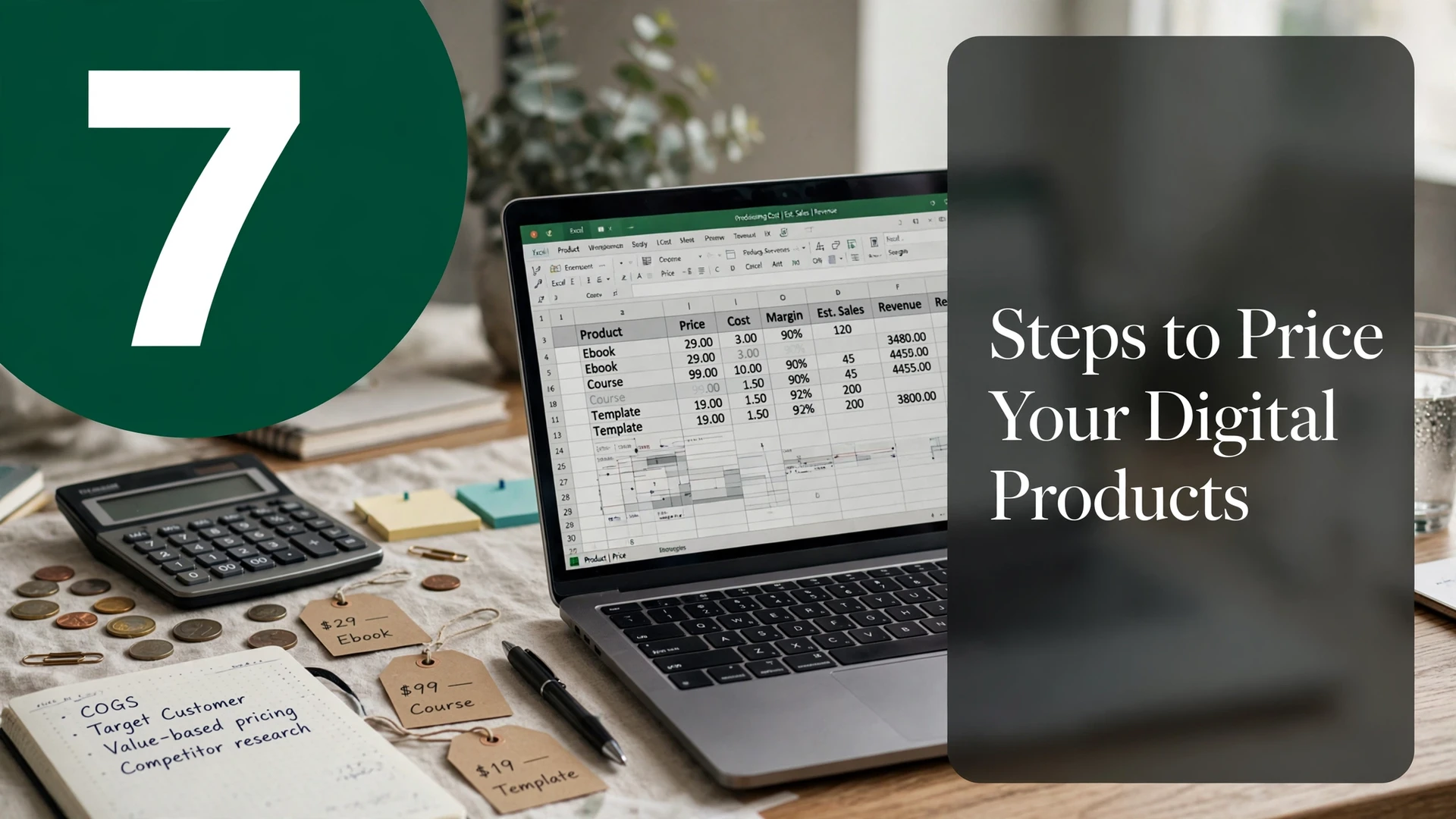
Follow these 7 steps to price your digital products for maximum sales and profit.
1. Research What Competitors Charge on Your Platform

Start by searching your product type on Etsy, Gumroad, or Creative Market. Note the price range for the top 10-15 bestsellers — not the cheapest listings, but the ones with the most sales and reviews. This gives you the market’s accepted price band. If similar planners sell for $5-12, pricing yours at $47 will confuse buyers. Your price should sit comfortably within (or just above, with justification) the proven range.
2. Calculate the Real Value Your Product Delivers

Forget about your costs for a moment — digital products have near-zero marginal cost. Instead, ask: what is this worth to the buyer? A budget spreadsheet that saves someone 5 hours a month is worth far more than the 3 hours it took you to make it. A resume template that helps land a $70,000 job justifies a $15-25 price easily. Anchor your price to the buyer’s outcome, not your effort.
3. Launch Low to Collect Reviews Fast

For your first product (or first 30 days), price 20-30% below your target. Early sales and 5-star reviews are worth more than the extra dollar per sale — they push you up in search rankings and build the social proof that lets you charge full price later. Think of the discount as a marketing investment, not lost revenue. Once you have 15-20 positive reviews, raise to your full price.
4. Create Bundles That Lift Your Average Order Value

Instead of discounting single products, bundle 3-5 related products at a slight discount versus buying separately. A $7 planner + $5 habit tracker + $6 meal planner sold individually ($18) becomes a “$24 value, yours for $14” bundle. Bundles increase your average order value, make buyers feel they’re getting a deal, and move more of your catalog per transaction. Every digital seller should have at least one bundle.
5. Test Different Price Points With Small Experiments

Don’t guess — test. Run your product at $9 for two weeks, then $12 for two weeks, and compare conversion rates and total revenue. A higher price with slightly fewer sales often earns more overall. Change only the price (keep title, images, and description identical) so you know the price caused the difference. Most sellers discover their optimal price is 20-40% higher than their first instinct.
6. Offer Tiered Pricing to Capture Every Buyer

Give buyers three choices: Basic (core product, lowest price), Standard (product + bonuses, mid price — make this the best value), and Premium (everything + personalization or commercial license, highest price). Most buyers pick the middle tier, but the premium tier captures high-value customers and makes the standard tier look reasonable. Tiered pricing routinely increases revenue 25-40% versus a single price.
7. Raise Prices Gradually as Demand Proves Itself

Your price is not permanent. Every 25-50 sales or every batch of glowing reviews is a signal you can charge more. Raise prices in small increments ($2-3 at a time) and watch conversion rates — if sales hold steady, the market accepts the new price. Sellers who never raise prices leave thousands on the table over a product’s lifetime. Review your pricing quarterly.
Frequently Asked Questions
What’s a good starting price for my first digital product?
For most printables and templates, $5-12 is a safe launch range. Ebooks typically start at $9-19. Simple tools and spreadsheets: $7-15. Start in the lower third of your competitors’ range, gather reviews, then move up.
Should I offer discounts and sales?
Occasional sales (holidays, product launches) work well and create urgency. But constant discounting trains buyers to wait and cheapens your brand. Run sales 3-4 times per year, not every week.
How do I price a bundle?
Add up the individual prices, then discount 20-30%. A bundle of five $8 products ($40 total) priced at $27-29 feels like a genuine deal while still earning you far more per transaction than a single sale.
Is it better to price high or low on Etsy?
Etsy’s buyers expect affordable prices — most digital products sell between $3 and $20. Premium pricing ($25+) works if your product solves an expensive problem (business templates, career tools) and your listing looks premium. Match your price to buyer expectations on each platform.
How often should I revisit my pricing?
Review quarterly. Check competitor prices, your conversion rate, and review sentiment. If you’re consistently selling out (digitally: high conversion with no complaints about price), you’re priced too low. If traffic is high but sales are low, price may be the barrier.
Conclusion
Pricing digital products is part research, part psychology, and part ongoing experiment. Start with competitor data, launch slightly low to build momentum, then test and raise as your reviews grow. The sellers earning the most aren’t necessarily the cheapest — they’re the ones who priced with intention and adjusted with data.