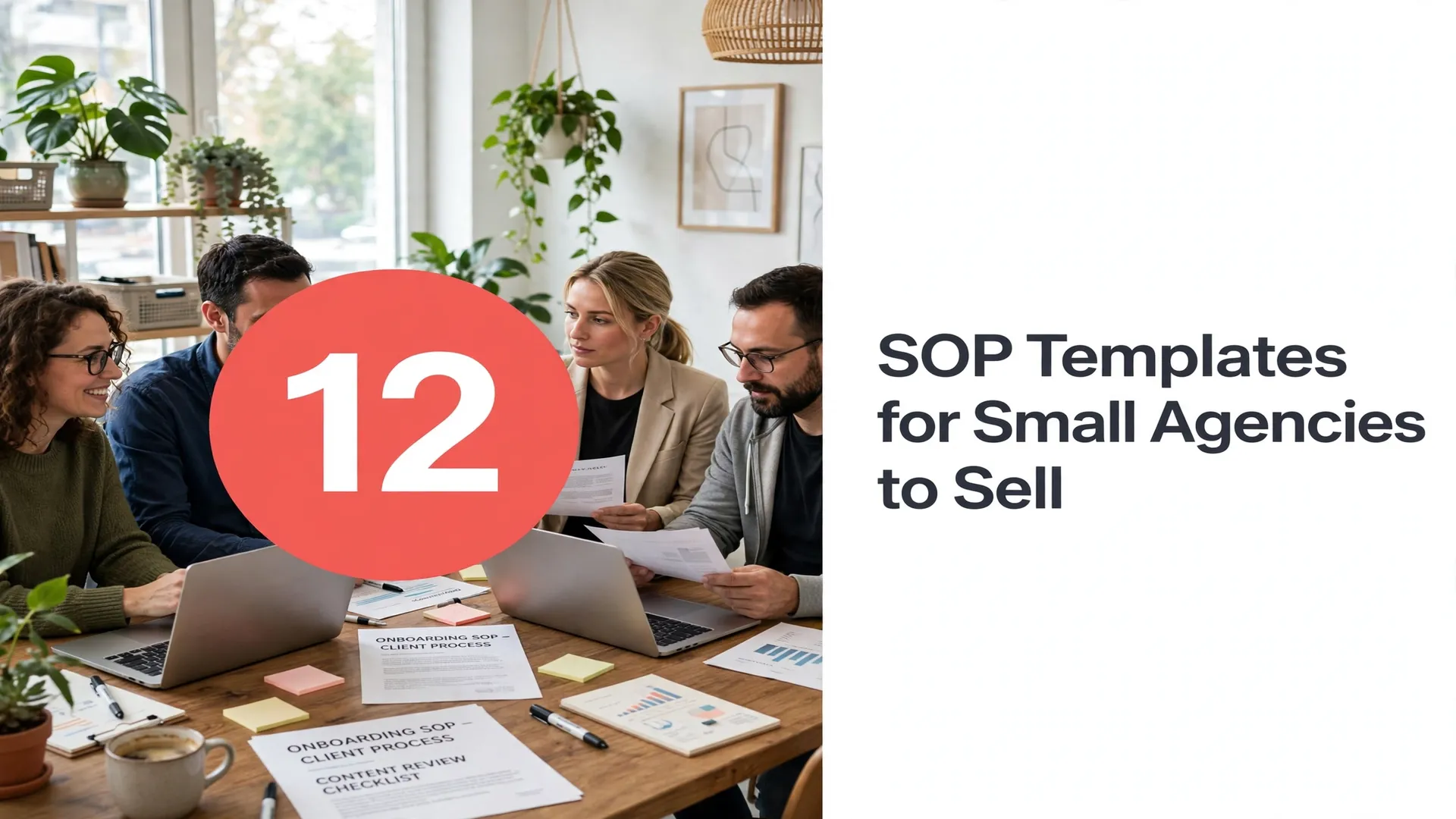
Small agencies run on repeatable work — the same discovery call, the same proposal, the same monthly report, done for client after client. That is why sop templates for small agencies sell so well: they save an agency owner hours of writing procedures from scratch and give a growing team one clear way to do each job. An SOP, or standard operating procedure, is a step-by-step document that says who does what, in which order, and how to know the job is done right. The templates below cover the full life of a client relationship, from the first call to the final invoice, and each one can be sold on its own or bundled into a complete agency operations pack. Price them as practical tools, not theory, and buyers will come back for the next pack.
1. Client Discovery Call SOP Templates

A discovery call SOP gives an agency a repeatable script for the first conversation with a prospect: the questions to ask, the red flags to listen for, and the notes to file before the call ends. A good template includes a pre-call checklist, a question flow that moves from goals to budget to timeline, and a simple scoring sheet so the team can decide quickly whether to send a proposal. Buyers love this template because bad-fit clients cost agencies far more than a lost sale, and a clear discovery process stops them at the door. If you also sell intake documents, a matching questionnaire makes this template even stronger — see how a focused intake document works in our guide to client questionnaire templates for photographers, where the same intake logic applies to any service business.
Tip: include a one-page call summary form in the template so the person who took the call can hand the notes to whoever writes the proposal without a second meeting.
2. Proposal and Quote SOP Templates for Agencies

A proposal SOP turns a scattered sales process into a checklist: confirm the scope, pick the right package, price it, draft the proposal, get it reviewed, and send it before the deadline the prospect was promised. The template should include a scope-confirmation step, because most proposal disputes start with a scope nobody wrote down. It should also set a turnaround time — 48 hours is a realistic standard for most small agencies — so prospects are never left waiting. Winning new work starts with a clear first project, and our guide to the steps to land your first freelance client shows the same disciplined follow-up that a proposal SOP should build into every deal.
Tip: add a pricing approval step for any quote above a set amount, so junior staff never discount a project without the owner signing off.
3. Client Contract and Payment SOP Templates

A contract and payment SOP covers what happens after a prospect says yes: send the contract, collect the signature, take the deposit, and set up the payment schedule before any work starts. The template should list the exact documents to send, the deposit percentage, the payment milestones, and what happens if a payment is late. Agencies buy this template because starting work without a signed contract and a deposit is one of the most expensive mistakes a small agency can make. Keep the language plain and practical, and note clearly that the template is a process guide, not legal advice, so buyers get their own lawyer to review the contract itself.
Tip: build in a “no work starts until deposit clears” rule with no exceptions — it is the single step that prevents most unpaid-work stories.
4. Project Kickoff SOP Templates for Agency Teams

A kickoff SOP makes sure every project starts the same way: the team knows the scope, the deadline, the client contact, and who owns each deliverable. The template should include an internal kickoff meeting agenda, a client kickoff call outline, and a checklist for setting up the project folder, the task board, and the communication channel. Without this step, projects start with different people holding different versions of the plan, and the confusion shows up in the final delivery. A strong kickoff template is short — one page of steps and one page of checklists — because a procedure nobody reads is worse than no procedure at all.
Tip: include a “single source of truth” rule in the template: one task board, one project folder, and one client contact, so nothing gets lost across tools.
5. Content Production SOP Templates for Client Campaigns

A content production SOP maps the journey of a single piece of content from brief to published: research, draft, edit, design, client review, schedule, and publish. The template should name who writes, who edits, and who approves, with a turnaround time for each stage so nothing sits in a queue for a week. It should also cover what happens when a draft comes back with heavy revisions, because that is where most content timelines fall apart. Agencies that run social, blog, or email work for several clients need this SOP most, since the same production steps repeat every week and small delays compound fast.
Tip: add a brief template inside the SOP so every piece of content starts from the same five questions — audience, goal, key message, call to action, and deadline.
6. Social Media Publishing SOP Templates for Agency Clients

A social media publishing SOP sets the daily and weekly rhythm for a client’s accounts: plan the content, write the captions, design or source the visuals, get approval, schedule, publish, and reply to comments. The template should include a monthly content calendar layout, a caption checklist, and a rule for how fast the team replies to comments and messages. It should also cover what to do when a post underperforms or a client asks for a last-minute change, because those two situations cause most of the stress in social media work. Buyers want this template to keep quality steady when more than one person touches an account.
Tip: include a two-person check before anything goes live — one person creates, another reviews — so a typo or wrong image never reaches a client’s audience.
7. Ad Campaign Setup SOP Templates for Paid Media Teams

An ad campaign setup SOP walks a team through launching a paid campaign without missing a step: confirm the budget, set up tracking, build the audiences, write the ads, set the targeting, launch, and check the first 48 hours of data. The template should include a pre-launch checklist for pixels, conversion tracking, and landing page links, because a campaign that runs without tracking wastes the client’s money from hour one. It should also set naming rules for campaigns and ad sets, so reporting stays readable when an account grows to dozens of campaigns. This is one of the highest-value templates in the pack, because a missed tracking step can cost a client far more than the template itself.
Tip: add a “pause and check” step 24 hours after launch, so a targeting error or broken link is caught on day one instead of at the end of the month.
8. Client Reporting SOP Templates for Monthly Results

A client reporting SOP turns the monthly report from a dreaded scramble into a routine: pull the numbers, write the summary, highlight wins and next steps, get it reviewed, and send it on the same day every month. The template should include a report outline with space for the three numbers that matter most to that client, plus a short plain-English summary, because clients rarely read a ten-page data dump. It should also cover what to do when results are weak — report honestly, explain why, and show the plan to fix it, instead of hiding the numbers. Agencies that report clearly keep clients longer, which is why this template sells well on its own.
Tip: set a fixed send date, such as the fifth working day of the month, and build the whole SOP backward from that date so the team always has time to prepare.
9. Revision and Approval SOP Templates for Client Work

A revision and approval SOP sets the rules for feedback: how many revision rounds are included, how feedback must be given, how long the client has to respond, and what happens when they ask for changes beyond the scope. The template should include a feedback form that asks for specific, actionable comments instead of vague notes like “make it pop.” It should also define who gives final approval on the client side, so work is never stuck waiting for five different people to agree. Endless revisions are one of the biggest profit leaks in agency work, and buyers know it — this template directly protects their margins.
Tip: include a “feedback deadline” rule: if the client does not reply within five working days, the work is treated as approved and the project moves forward.
10. Invoicing and Late Payment SOP Templates

An invoicing SOP covers the money side of agency work: when to invoice, what to include, who sends it, and what happens when payment is late. The template should map the full sequence — invoice on the agreed date, send a friendly reminder at seven days, a firm reminder at fourteen, and pause work at thirty — so nobody has to improvise an awkward conversation. It should also include invoice and reminder email templates, because the words matter when a relationship is at stake. Small agencies buy this template because chasing payments is the task owners put off longest, and a written procedure makes it routine instead of personal.
Tip: add a monthly accounts check to the SOP so overdue invoices are spotted in one short meeting instead of discovered months later.
11. Client Offboarding SOP Templates for Finished Projects

A client offboarding SOP covers the end of a project with the same care as the start: deliver the final files, hand over logins and assets, close the accounts, send the final invoice, and ask for a testimonial and a referral. The template should include a handover checklist and a short exit survey, because a clean ending is what turns a finished client into a returning one. It should also set a rule for how long files are kept after the project ends, so the agency is not storing client data forever. Many agencies skip this step entirely, which is exactly why buyers are willing to pay for a template that gets it right.
Tip: include a testimonial request in the offboarding sequence, timed for the week the client is happiest — right after a successful delivery, not months later.
12. Quality Review SOP Templates Before Client Delivery

A quality review SOP is the final gate before anything reaches a client: check the work against the brief, proofread it, test every link, confirm the branding, and get a second pair of eyes on it. The template should include a short review checklist for each type of deliverable — a report, a design, an ad, a post — so the reviewer knows exactly what to check. It should also name who has the authority to send work to the client, because a review step with no owner gets skipped under deadline pressure. This template is the one that protects an agency’s reputation, and it is a natural upsell at the end of any SOP pack.
Tip: keep the checklist to ten items or fewer — a review list nobody finishes is no better than no review at all.
Frequently Asked Questions
What is an SOP template for a small agency?
An SOP template is a ready-made, step-by-step procedure document that an agency can adapt to its own work. It lists who does each step, in what order, and how to check the job is done, so the whole team follows the same process instead of each person inventing their own.
Where can I sell SOP templates for small agencies?
Etsy, Gumroad, and Creative Market are the most common marketplaces, and many sellers also offer them on their own websites. List them with a clear preview of the table of contents and a sample page, so buyers can see the quality before they purchase.
How much should I charge for SOP templates?
Single SOP templates commonly sell for $9 to $29, while a full pack of ten or more procedures often sells for $49 to $149, depending on depth and design. Price higher when the template includes checklists, forms, and email scripts, not just a list of steps.
Do SOP templates need to be industry-specific?
Not always, but specific sells better. A generic operations pack competes with hundreds of similar listings, while a pack written for marketing, design, or social media agencies speaks directly to a buyer who recognizes their own workflow in the preview.
Can I sell the same SOP template pack more than once?
Yes — that is the point of a digital product. You create the pack once and sell it again and again, updating it when buyers ask for a new procedure or when a platform changes. Keep a simple version note so repeat buyers can see what improved.
Agencies do not buy SOP templates because they love paperwork — they buy them because repeatable work is profitable work. Build each template around a real job an agency does every week, include the checklists and forms that make it usable on day one, and sell the pack as a complete system rather than a pile of documents. Start with the three procedures your buyers ask about most, then grow the pack from there.