Print on demand is passive income with training wheels: you upload designs, a provider prints and ships physical products, and you pocket the margin — no inventory, no packing boxes. These 8 print on demand ideas focus on proven niches where physical products keep selling long after the design work is done.
1. Profession and Trade T-Shirt Lines
Nurses, electricians, teachers, truckers, and welders all buy shirts that celebrate their trade — and they buy them for coworkers too. A single clever design (“Electricians Have Current Relationships”) can sell steadily for years because every graduating class and new hire is a fresh customer. Price shirts at $24.99 and keep $8 to $10 profit per sale after the provider’s base cost.
Research each trade’s inside jokes on Reddit and Facebook groups before designing; authenticity sells. Launch with 5 to 10 designs per profession so buyers browse a mini-collection instead of a single shirt.

2. Humorous Pet Breed Merchandise
Dog and cat owners are famously willing to spend on breed-specific humor — “My Golden Retriever Is My Co-Pilot” on a mug or hoodie practically sells itself. Each breed is its own micro-niche with passionate buyers, and pet products have huge gift potential around holidays. Mugs and sweatshirts carry the best margins, often $7 to $12 profit per item.
Start with the 10 most popular breeds, then expand into less-served ones where competition is thinner. Pair every design with matching products (mug + shirt + tote) so one buyer becomes three sales.

3. Oversized Gallery Wall Art Prints
Large-format art prints (18×24 and up) command premium prices — $40 to $80 per print with $15 to $30 profit — because they solve a real decorating problem. Abstract landscapes, city skylines, and botanical prints in coordinated color palettes sell best; buyers often purchase sets of three. Unlike digital printables, POD art arrives framed and ready to hang, which justifies the higher price.
Design in matching sets rather than single pieces, and mock up the art in styled room photos for your listings. Customers who can picture it on their wall convert far more often.

4. Custom Photo Calendars and Memory Books
Personalized photo calendars are a perennial Q4 bestseller — grandparents, in-laws, and coworkers buy them every single December. POD providers print each calendar with the customer’s uploaded photos, so you just provide the template layout once and collect margin on every order. A $29.99 calendar typically nets $8 to $12.
Launch your calendar templates by early October to catch the full holiday wave, and offer matching photo books as an upsell. Evergreen layouts (no year printed on the cover art) can sell year-round as planners and journals.

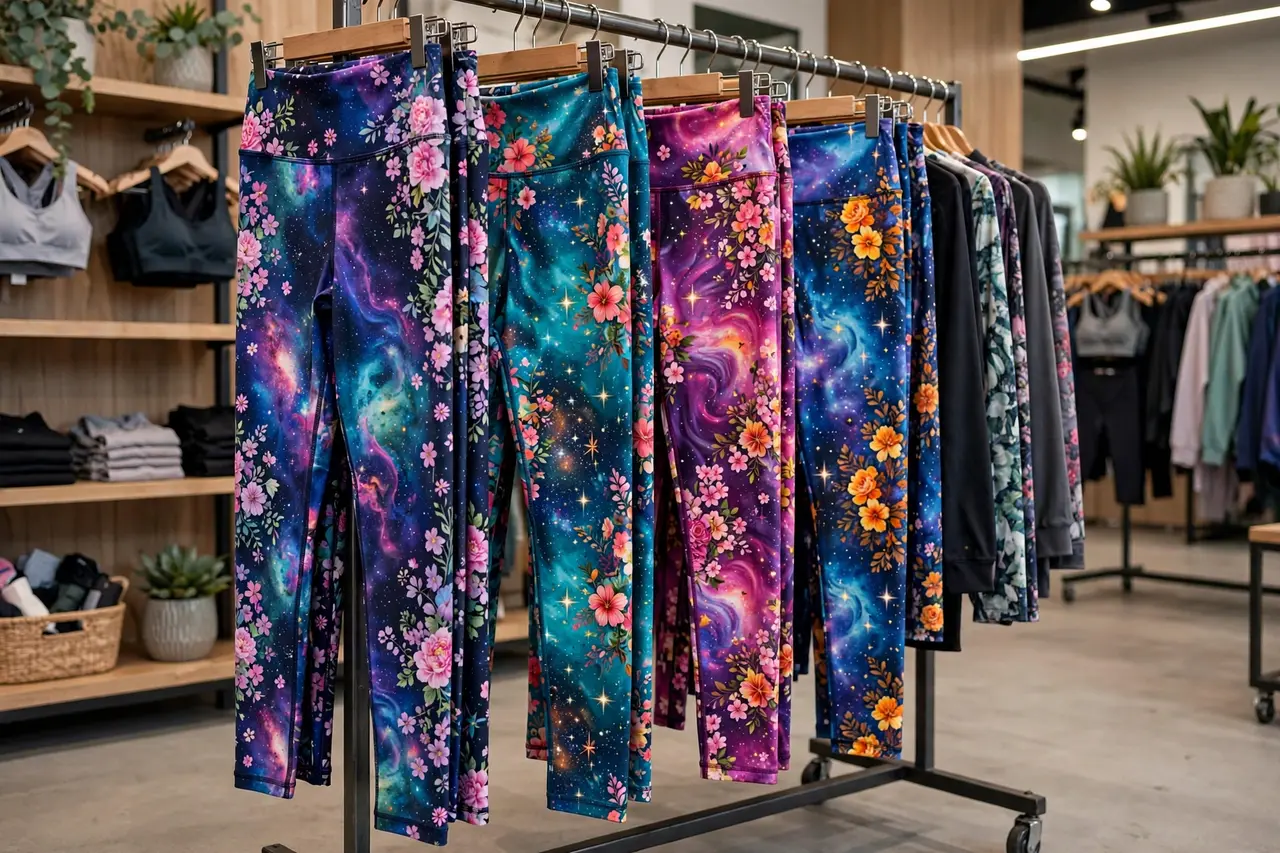
5. All-Over-Print Leggings and Activewear
All-over-print activewear stands out in a crowded apparel market because the designs wrap the entire garment — bold patterns buyers can’t find in stores. Yoga-inspired prints, galaxy designs, and artistic florals sell at $45 to $60 with $12 to $18 profit per pair. The fitness and festival crowds reorder in multiple patterns once they trust your fit.
Order samples to verify print quality and sizing before scaling; activewear buyers are picky and returns hurt. Niche down hard — “celestial yoga leggings” beats generic “pretty leggings” every time.
6. Personalized Wooden-Style Family Signs
Family name signs (“The Millers — Est. 2012”) are wedding, anniversary, and housewarming staples that never go out of style. POD providers print them on wood-look substrates that mimic expensive custom carpentry at a fraction of the cost. At $39.99 retail, profits run $12 to $18 per sign, and personalization kills price comparison.
Offer 4 to 5 design styles (farmhouse, modern, rustic) with an easy personalization field at checkout. These make perfect gifts, so lean into holiday marketing from October through December.

7. Seasonal and Holiday Gift Collections
Holiday collections are print on demand’s Super Bowl: Christmas, Halloween, and Mother’s Day drive massive spikes where a single winning design can fund your whole year. Build a reusable library of 20 to 30 seasonal designs — funny Halloween shirts, elegant Christmas ornaments, heartfelt Mother’s Day mugs — and relaunch them every year with fresh mockups. Seasonal items routinely outsell evergreen products 5-to-1 in Q4.
Upload seasonal designs 60 to 90 days before the holiday so search algorithms index them in time. Keep last year’s winners live year-round; early-bird shoppers buy Christmas gifts in October.

8. Abstract Canvas Prints for Modern Homes
Canvas prints occupy the sweet spot between cheap posters and expensive original art — buyers pay $50 to $120 for something that looks gallery-worthy. Abstract and minimalist designs in neutral tones match modern decor trends and photograph beautifully for listings. With $20 to $40 profit per canvas, just a few sales a week becomes serious passive income.
Offer each design in three sizes so budget buyers and statement-piece hunters both convert. Free-shipping thresholds nudge single-canvas buyers into ordering pairs.

Frequently Asked Questions
How much can you realistically earn with print on demand?
Beginners typically earn $100 to $500 a month in the first six months with 30 to 50 designs live. Sellers with 200+ optimized designs across winning niches commonly report $1,000 to $5,000 monthly — the catalog compounds.
Do I need design skills to start print on demand?
No — text-based designs and simple graphics sell extremely well, and free tools like Canva handle most of it. Many top sellers never touch Photoshop; clever phrases beat fancy artwork in most niches.
Which print on demand provider is best for beginners?
Printful and Printify lead for quality and integrations, while Amazon Merch on Demand offers built-in traffic. Start with one provider, master a single niche, and expand only after your first consistent sales.
Is print on demand still profitable with so much competition?
Yes, but generic designs are dead — niching down is everything. “Funny nurse shirts” has competition; “funny neonatal ICU nurse shirts” has buyers and breathing room. Specificity is the moat.
Conclusion
Print on demand rewards the patient: upload quality designs in tight niches, let search traffic compound, and reinvest early profits into more designs. Pick one idea from this list, publish your first 10 designs this week, and you’ll own a small passive income asset by year’s end.