
Most dividend stocks pay every three months, which makes monthly budgeting awkward for beginners. That is why monthly dividend ETFs attract so much attention: they bundle many income-producing holdings into one fund and aim to distribute cash every month instead of every quarter. Monthly does not mean safer or guaranteed, and some monthly funds carry risks that quarterly funds do not. Use the twelve categories and checks below to compare funds carefully, read each fund’s prospectus, and decide whether any monthly fund fits your goals.
Related: dividend investing tips and passive income ideas for retirees.
1. Broad Monthly-Paying Dividend ETFs to Compare First
Broad monthly dividend ETFs hold a wide mix of dividend-paying companies across several industries, which spreads the risk that any single company cuts its payout. Beginners often start their research here because one fund can replace dozens of individual stock picks. Look at what the fund actually holds, how many positions it owns, and whether any single sector dominates the portfolio.
Compare at least three broad funds side by side before narrowing your list, and pay attention to how long each fund has existed. Broad does not mean boring: it is usually the calmest starting point for monthly income research.

2. Covered-Call ETFs That Generate Monthly Cash From Options
Covered-call ETFs earn part of their monthly cash by selling options on stocks they already own, which can produce frequent distributions. The trade-off is important to understand: when markets rise strongly, these funds may give up some upside in exchange for that steady option income.
Read how each fund describes its options strategy, how often it writes calls, and what happens to its share price during rising markets. Covered-call funds suit research for investors who value regular cash flow over maximum growth, but they deserve extra scrutiny from beginners. Never judge one by a single month’s distribution alone.

3. Monthly Real Estate Income ETFs Built Around Property Rents
Real estate income ETFs hold property companies and real estate investment trusts, which earn money largely from rents. That rent-based income is one reason these funds can aim for monthly distributions. Their performance, however, follows property markets, interest rates, and occupancy trends, so they can fall when real estate cools.
Check whether the fund focuses on apartments, offices, warehouses, healthcare properties, or a mix, because each property type behaves differently. A diversified property mix usually steadies research, while a single property type adds concentration risk.

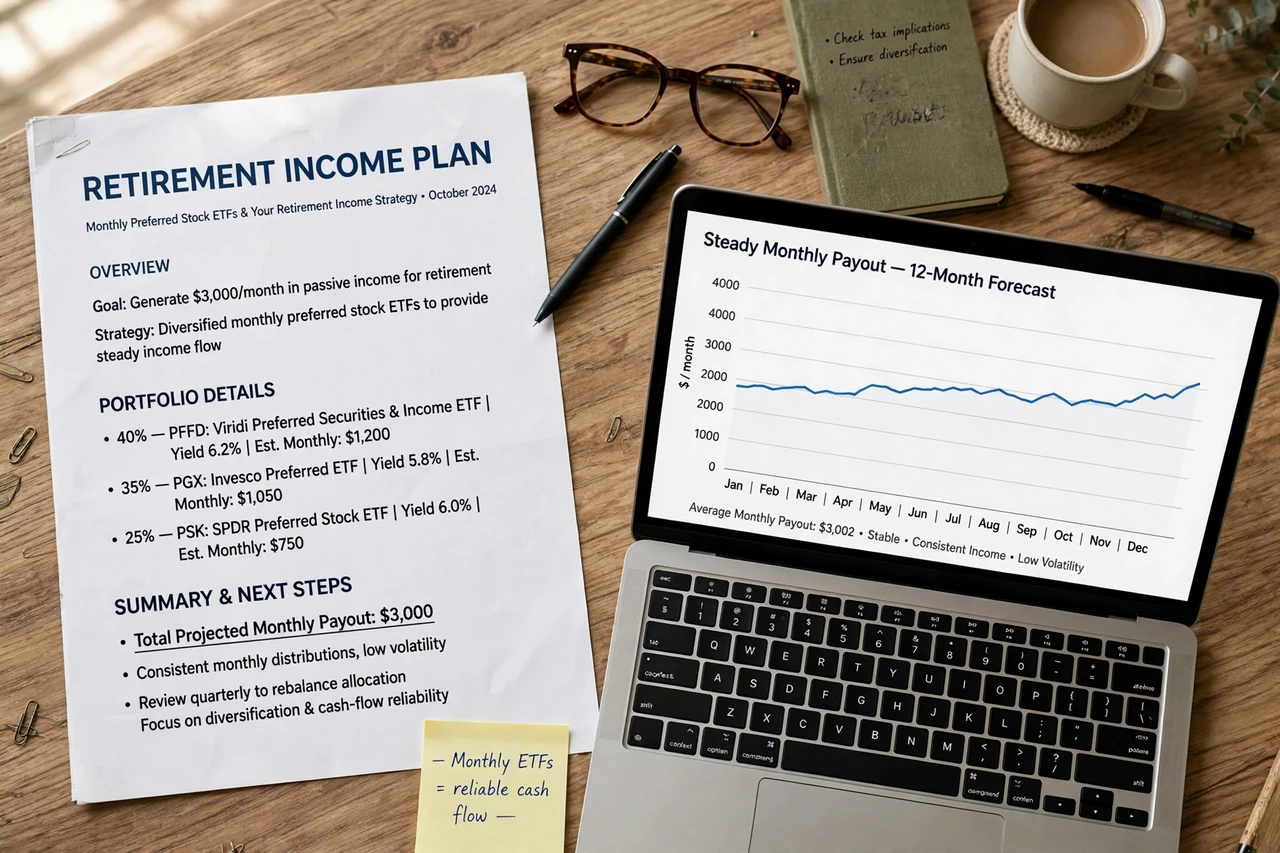
4. Monthly Preferred Stock ETFs and Their Place in an Income Plan
Preferred stock ETFs hold a hybrid security that sits between common stock and bonds: preferred shares usually pay a fixed dividend and rank ahead of common shares if a company struggles. That structure can support monthly income, but preferred shares can also fall in value when interest rates rise, and companies can suspend preferred dividends in severe stress.
Study the credit quality of the underlying issuers, the fund’s sector mix, and whether it concentrates in banks and financial firms. Preferred funds can complement common-stock dividend funds, but they are not a substitute for bonds or cash reserves.
5. Monthly Bond-Heavy Income ETFs for Steadier Payouts
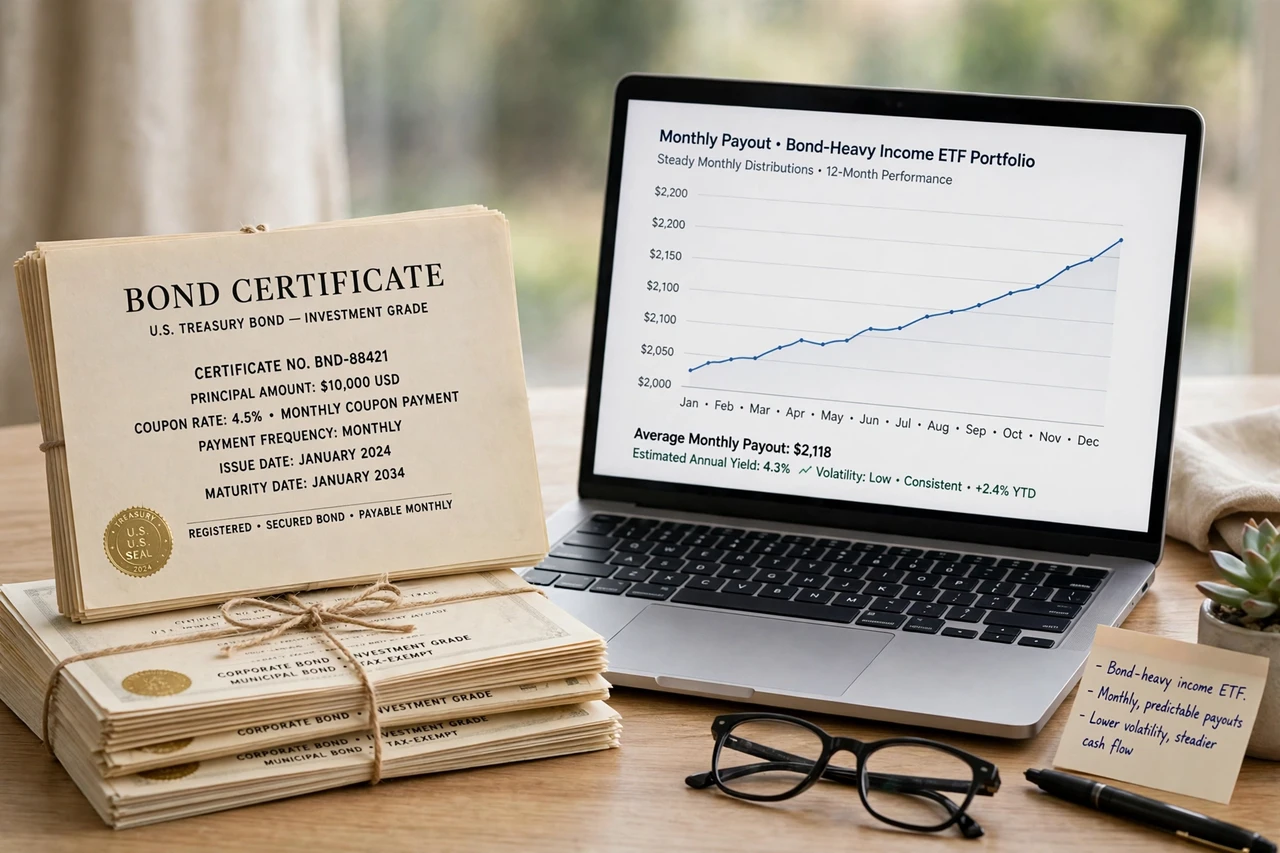
Bond-heavy monthly ETFs hold government, corporate, or mixed bonds and pass interest through to investors each month. Bonds tend to move differently from stocks, which can steady an income portfolio during equity sell-offs. They still carry risks, including interest-rate risk, inflation risk, and credit risk if corporate borrowers weaken.
Look at the fund’s average bond maturity, credit quality, and expense ratio, and compare how it performed during past rate rises. Shorter-maturity bond funds usually move less when rates change, while longer-maturity funds react more. For beginners, bond-heavy monthly funds are often a steadier research starting point than the highest-paying equity funds.
6. Monthly International Dividend ETFs for Currency and Market Spread
International monthly dividend ETFs hold dividend-paying companies outside the United States, adding geographic and currency variety to an income plan. Different countries pay dividends on different schedules and face different economic cycles, which can smooth or complicate monthly cash flow. Currency moves can also raise or lower the value of your distributions when converted to dollars.
Check which regions the fund covers, whether it hedges currency risk, and how its holdings differ from your US funds. International exposure can diversify an income portfolio, but it also adds tax and reporting complexity for some investors. Research it as a complement to domestic funds, not as a replacement for them.

7. Monthly Small-Cap Dividend ETFs and Their Extra Volatility
Small-cap dividend ETFs hold smaller companies that pay dividends, and their share prices can swing more sharply than large-company funds. Smaller firms may grow faster, but they also have thinner financial cushions, which makes their dividends less certain during recessions. Monthly distributions from these funds can therefore be less steady than their marketing suggests.
If you research this category, keep the position modest relative to broad funds, and study how the fund behaved during past downturns. Small-cap monthly funds can add growth potential to an income plan, but they are better suited to investors who can tolerate larger price swings without selling in panic. Beginners should compare them last, not first.

8. Monthly Dividend Growth ETFs That Raise Payouts Over Time
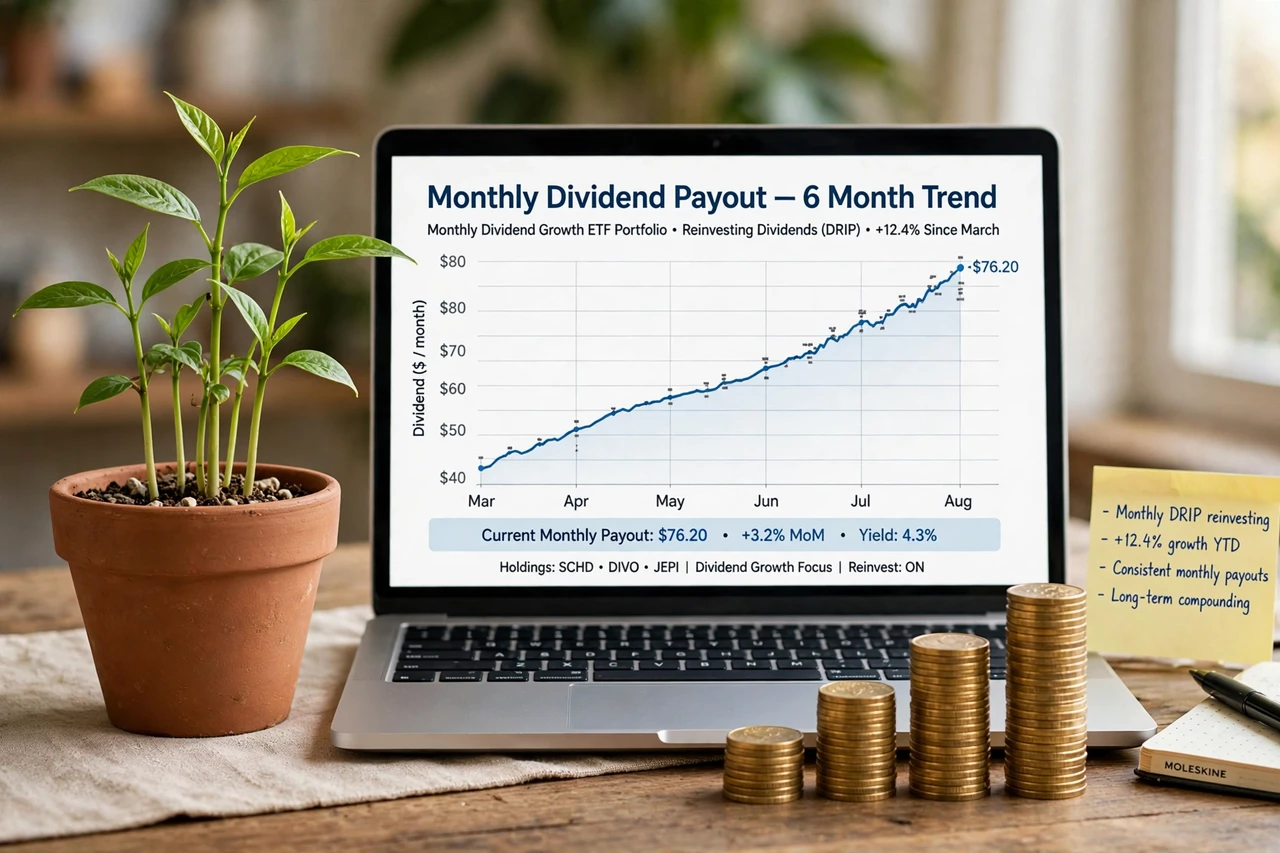
Dividend growth ETFs focus on companies with a history of raising dividends, rather than simply paying the highest current amount. Their monthly distributions may start smaller, but the goal is growth that helps income keep pace with rising living costs over many years. This category rewards patience: the benefit compounds slowly, not in a single month.
Review the fund’s record of distribution growth, its holdings’ dividend histories, and whether growth came from underlying companies or from fund mechanics. A genuine dividend growth fund should show a pattern of rising payouts supported by rising company earnings.
9. Monthly Leveraged Income ETFs and Why Beginners Should Pause
Leveraged income ETFs use borrowing or derivatives to amplify exposure, which can also amplify losses and distribution swings. Their monthly payouts may look attractive at first glance, but leverage can erode value over time, especially in volatile markets. These funds are designed for short-term, sophisticated use, not for steady beginner income.
Beginners should research this category mainly to recognize and avoid it until they fully understand leverage, daily reset mechanics, and decay. If a monthly fund’s description mentions leverage, amplified exposure, or daily objectives, treat that as a warning flag. Steady income plans rarely need leverage to work.

10. Reading a Monthly ETF’s Distribution History Before You Buy
A fund’s distribution history tells you far more than its latest monthly payment. Look for several years of records, note whether distributions rose, fell, or stayed flat, and check how the fund performed during market stress. A fund that maintained steadier distributions through a downturn deserves more attention than one with a single strong month.
Also check whether distributions came from dividends, interest, capital gains, or return of capital, because each source affects taxes and sustainability differently. Free fund fact sheets and prospectuses publish this breakdown. Make distribution history a required step in your research, and skip any fund whose history you cannot find or explain.

11. Comparing Expense Ratios Across Monthly Dividend ETFs
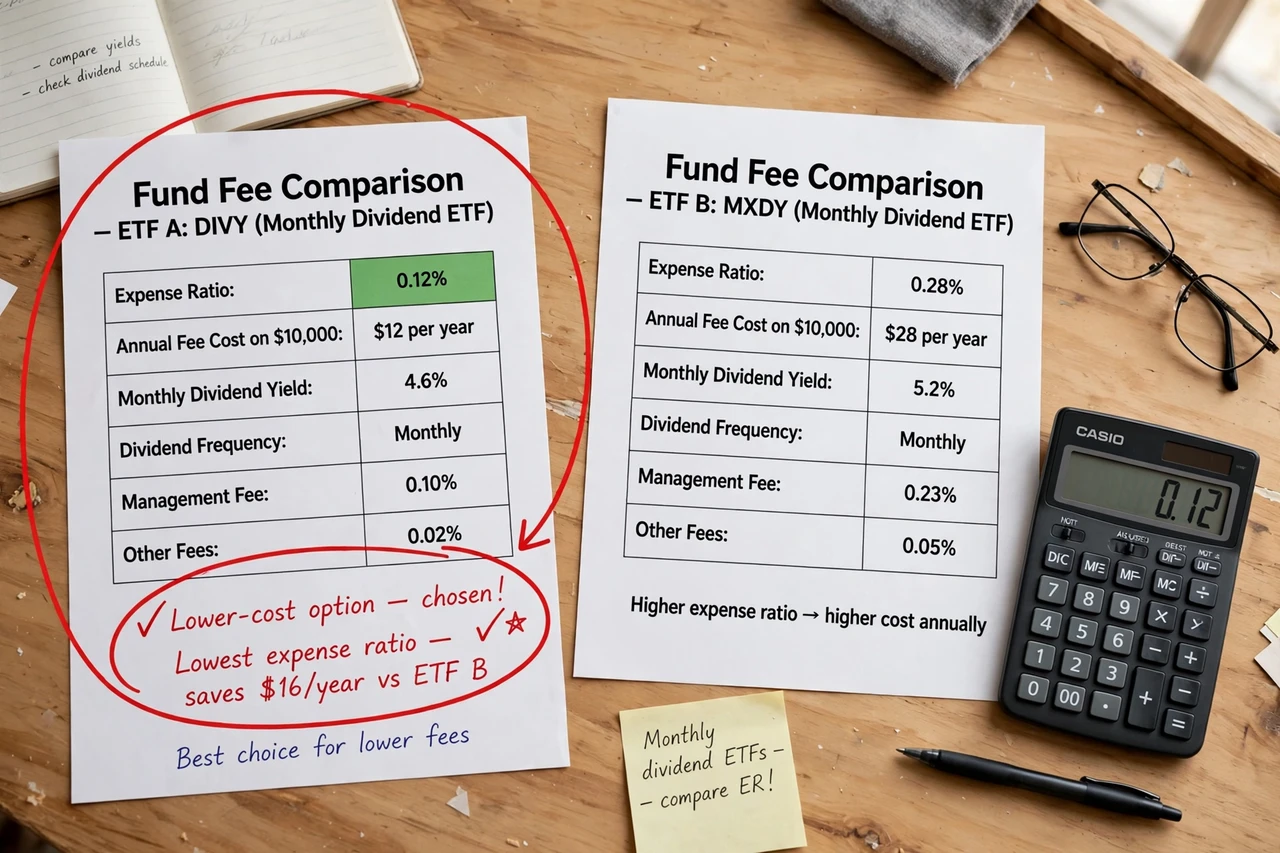
Expense ratios are the annual fees a fund charges, and they quietly reduce your income every year. Monthly dividend ETFs vary widely: broad index-style funds often charge less, while specialized or actively managed monthly funds can charge much more. Over decades, even a small fee difference compounds into a meaningful gap.
Compare fees only among funds in the same category, because a complex strategy may justify a higher fee than a simple broad fund. Still, demand a reason for every extra fee: what does the fund do that a cheaper alternative does not? For beginners, low-cost broad monthly funds usually make the strongest starting comparison.
12. Checking How Much of a Monthly Payout Is Return of Capital
Return of capital happens when part of a distribution comes from returning your own invested money rather than from earnings. It is not automatically bad, but a high share of return of capital can shrink your investment base over time and signal that payouts exceed what the fund actually earns. Beginners often miss this because the monthly cash still arrives on schedule.
Find the fund’s distribution composition in its annual report or tax documents, and ask whether return of capital appears regularly or only occasionally. A fund that consistently returns capital deserves hard questions before any investment. Pair this check with distribution history, and you will avoid many monthly funds that look steady only on the surface.

Frequently Asked Questions
Are monthly dividend ETFs safer than quarterly dividend stocks?
No. Monthly payment frequency says nothing about safety. A monthly fund can hold risky assets, use leverage, or return capital, while a quarterly stock can be far steadier. Judge safety by holdings, history, fees, and distribution sources, not by payment frequency.
Do monthly dividend ETFs guarantee monthly income?
No. Funds can reduce, suspend, or vary distributions, and share prices can fall. Monthly ETFs aim for regular distributions, but nothing guarantees them. Build an income plan that can handle a lower month without forcing you to sell investments at a bad time.
Should beginners start with monthly ETFs or individual dividend stocks?
Most beginners find ETFs easier to research because one fund spreads risk across many holdings. Start by comparing broad monthly funds, learn how distributions work, and only consider individual stocks after you understand payout sustainability and sector risk.
How are monthly ETF distributions taxed?
Tax treatment depends on the source: qualified dividends, ordinary dividends, interest, capital gains, and return of capital are taxed differently. Check the fund’s tax documents and consider holding tax-inefficient funds in retirement accounts. When in doubt, ask a qualified tax professional about your situation.
How much should I put into monthly dividend ETFs?
There is no universal amount. Many beginners start small, learn how distributions and price swings feel, and add gradually as their research improves. Keep emergency savings separate, avoid investing money you need soon, and diversify beyond any single fund or category.