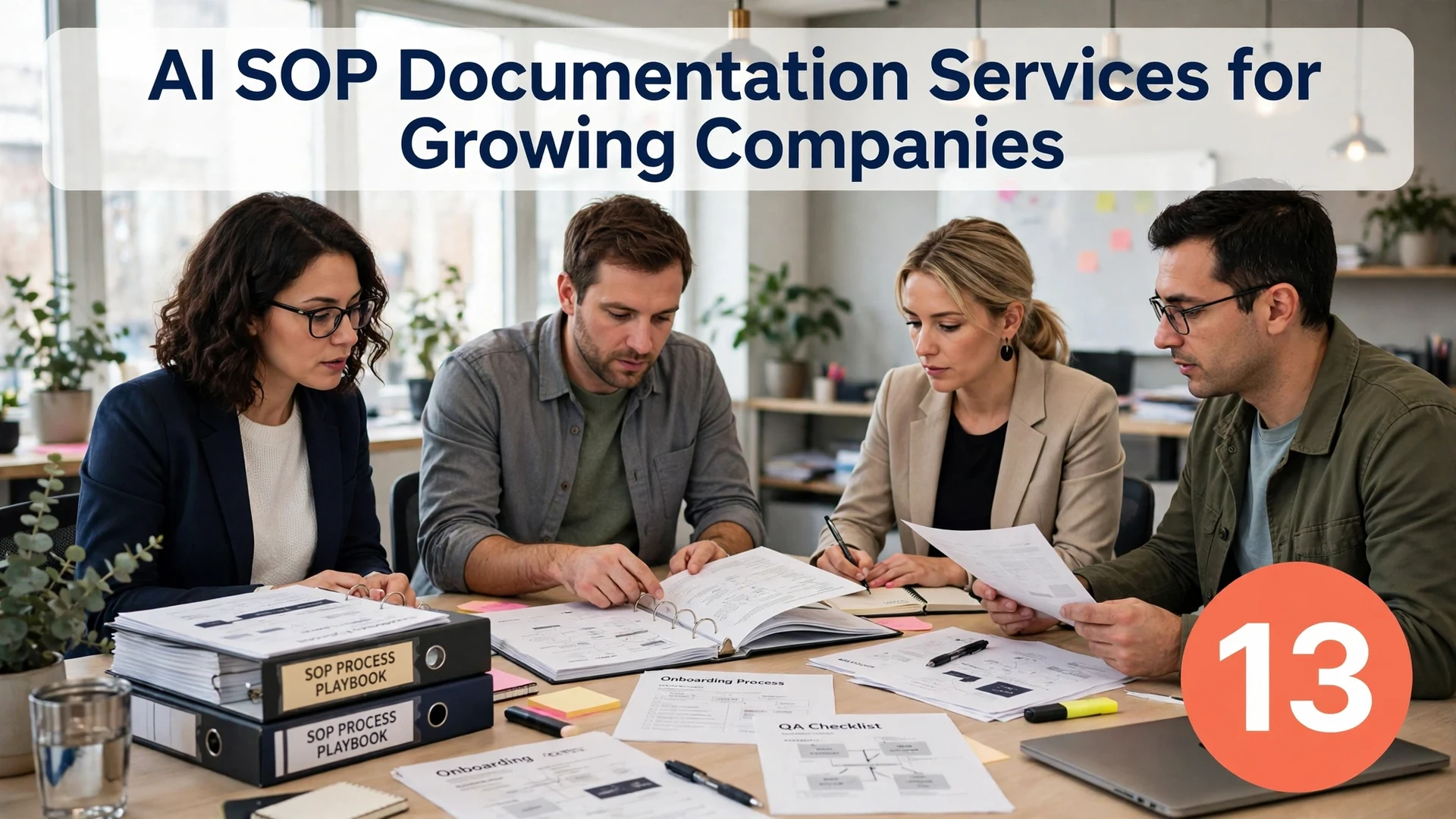
Every growing company hits the same wall: the founder knows how everything works, the first ten employees figured it out by asking, and employee number thirty has nobody to ask. Work slows down, mistakes repeat, and quality depends on who happens to be in the room. AI SOP documentation services solve that problem by turning scattered know-how into clear, step-by-step playbooks a new hire can follow on day one. You interview the people who do the work, use AI to draft and organize the steps, and deliver a polished document the company actually uses. A good playbook cuts training time and errors. Freelancers can start with these AI tools for freelancers.
1. New Hire Onboarding Playbooks for Scaling Teams

When a company hires five people in a month, onboarding usually collapses into shadowing whoever is free that day. A new hire onboarding playbook fixes that with a first-week plan, account setup checklist, key contacts, and the ten tasks every new hire must learn before working alone. You build it by interviewing managers and recent hires, then using AI to organize their answers into a logical order and flag gaps, such as a tool nobody mentioned until week three.
Sell this per role, since growing companies hire the same roles repeatedly.
2. Customer Support Reply Playbooks for Growing Help Desks

As ticket volume grows, support quality becomes inconsistent: one agent solves a refund in minutes, another escalates it for days. A customer support reply playbook collects the best answers, escalation rules, and refund limits into one document, with AI helping to group hundreds of past tickets into the twenty situations that cover most of the work. New agents answer confidently, customers get consistent replies, and managers stop rewriting the same answer in chat.
Update it monthly at first, since support issues change as products change.
3. Sales Handoff Playbooks From Lead to Closed Deal

Deals fall apart in the handoff between marketing, sales, and delivery, when nobody owns the next step. A sales handoff playbook defines exactly what information moves at each stage, who owns it, and what a qualified lead looks like before it passes to the next team. You map the current process by talking to each team, use AI to draft the steps and checklists, and then test the draft against two real recent deals to find the missing pieces.
Price it as a project with a thirty-day follow-up review, when the team can flag steps that still cause friction.
4. Quality Check Playbooks for Expanding Production Teams

When a production team doubles, quality usually drops, because the checks that lived in a senior worker’s head never got written down. A quality check playbook lists each inspection point, what passing looks like, what to do when something fails, and who signs off before shipment. AI helps you turn rough notes and photos into clear steps, but you must verify every standard with the team lead, because a wrong tolerance in a playbook is worse than no playbook at all.
This suits makers and food producers adding shifts or a second location, when reputation is most at risk.
5. Vendor and Supplier Playbooks for Multi-Location Companies

Companies opening a second or third location often discover that supplier relationships, ordering rules, and payment terms exist only in the founder’s email. A vendor and supplier playbook documents approved vendors, ordering steps, approval limits, and what to do when a delivery fails. You gather the information from purchasing staff and the founder, organize it with AI, and create a version each location manager can actually use without calling headquarters.
Offer a short quarterly update, since vendors and prices change often.
6. Remote Team Communication Playbooks for Distributed Staff

Remote teams waste hours on unclear expectations: which channel is urgent, how fast should someone reply, and when is a meeting actually needed? A remote team communication playbook answers those questions once, with channel rules, meeting norms, response-time expectations, and a simple escalation path. You build it by surveying the team about their real frustrations, then using AI to draft norms that fit how they already work, rather than imposing rules from a textbook.
It is an easy first project, since every employee has an opinion about communication, which makes interviews fast.
7. Safety and Compliance Playbooks for Growing Warehouses

A warehouse that adds staff and shifts without updating its safety procedures is taking a serious risk. A safety and compliance playbook covers equipment checks, incident reporting, emergency exits, and the training each role must complete before working alone. You must base this on the company’s actual equipment and local rules, and have a qualified manager review it, because AI drafts are a starting point, not a legal opinion, and safety content must be accurate.
Price this work carefully and take the review step seriously; companies will respect a provider who insists on expert sign-off. A trustworthy safety playbook is a long-term asset, and the company will return to you for every new site.
8. Content Publishing Playbooks for Expanding Marketing Teams

When a marketing team grows from one person to five, publishing turns chaotic: drafts live in personal drives, nobody knows who approves what, and posts go out with errors. A content publishing playbook defines the workflow from idea to published post, including briefs, review steps, brand rules, and a publishing checklist. AI helps you draft templates and checklists from the team’s current habits, while you add the missing approval step that usually causes the chaos.
Once the publishing playbook works, the team often asks for social, email, and video versions too.
9. Finance Approval Playbooks for Companies Adding Staff

Fast-growing companies often approve spending informally until one surprise expense forces a crisis. A finance approval playbook sets spending limits by role, the approval chain for larger purchases, and the exact steps for reimbursements and vendor payments. You interview finance staff and managers, use AI to organize thresholds and forms into a readable document, and include examples, because a rule without an example is usually misunderstood.
Keep it practical, not bureaucratic, or managers will route around it.
10. Brand Consistency Playbooks for Companies Opening New Locations

A company opening new locations risks looking like a different business in each city, with different signage, greetings, and service standards. A brand consistency playbook documents the customer experience end to end: how staff greet customers, how the space should look, which phrases to use, and how complaints are handled. You build it by visiting or interviewing the best-performing location, then turning its habits into standards every new location can copy.
New-location managers love a playbook that answers questions before opening day, and headquarters loves the consistency.
11. Returns and Refund Playbooks for Scaling E-Commerce Brands

E-commerce brands that scale suddenly face return volumes their original team never planned for, and inconsistent decisions frustrate customers. A returns and refund playbook sets the rules for common cases, damaged items, late returns, and exchanges, plus the exact steps and messages for each one. AI helps you group past return reasons into patterns, so the playbook covers the situations that actually happen, not imaginary ones.
Pair it with a short training session, because a playbook nobody reads is just a file.
12. Emergency Response Playbooks for Companies Outgrowing Informal Habits

Small companies handle emergencies by calling the founder, but that stops working at fifty employees. An emergency response playbook names who decides what, how staff are notified, and the first five steps for common situations such as a system outage, a facility problem, or a public complaint. You draft it from interviews with managers, use AI to organize scenarios and checklists, and run a short tabletop walkthrough so the team finds the gaps before a real emergency does.
Pitch it after a growth milestone, such as a new office or hiring round; the walkthrough reveals problems in twenty minutes.
13. Quarterly SOP Refresh Service That Keeps Playbooks Current

The biggest reason SOP projects fail is that nobody updates them, and within a year the playbook describes a company that no longer exists. A quarterly SOP refresh service solves that: every three months you interview team leads, note what changed, update the affected playbooks, and remove steps nobody follows anymore. AI speeds up the comparison between old and new versions, but your judgment decides what stays, what goes, and what needs a manager’s sign-off.
Sell the refresh as a retainer attached to every playbook project; an outdated playbook is worse than useless.
Frequently Asked Questions
How is an AI SOP service different from just asking AI to write a manual?
AI alone produces generic steps that do not match how a specific company works. Your service adds interviews, real examples, and testing against actual work, which is what turns a generic document into a playbook employees trust and follow. New to AI work? See these AI side hustle ideas for beginners.
Do I need experience in the client’s industry?
Not necessarily, because you document the client’s own process rather than inventing one. Industry experience helps you ask better questions, but careful interviewing and expert review matter more than prior knowledge of the field.
How long does one SOP playbook take to deliver?
A single focused playbook usually takes one to three weeks, depending on interview availability and review rounds. Multi-playbook projects for a whole company can take a month or more, which is why phased delivery works well.
How should I price SOP documentation services?
Single playbooks commonly sell for $500 to $2,000, while full company packages range from $3,000 to $10,000 or more. Quarterly refresh retainers often add $300 to $800 per month, depending on how many playbooks you maintain.
What if employees resist following the new playbook?
Involve them in building it, keep steps short and realistic, and test the draft with the people who will use it. A playbook built with employees, rather than handed to them, faces far less resistance and gets used far longer.