
Income investors often notice high-yield dividend funds first because their payouts stand out next to ordinary savings rates. A high payout, however, always comes with a reason, and that reason is usually extra risk, such as weaker borrowers, concentrated property exposure, or leverage. The eight fund types below explain where high yields come from, what can go wrong, and which checks matter before you research any fund further. Treat every category as a starting point for reading prospectuses, not as a shortlist to buy from.
Related: dividend investing tips and passive income ideas for retirees.
1. High-Yield Bond Funds and the Credit Risk Behind Their Payouts
High-yield bond funds hold bonds from companies with lower credit ratings, which pay more interest because lenders demand compensation for higher default risk. When the economy is strong, these funds can pay steadily, but during recessions, defaults rise and both prices and payouts can fall together. That correlation with economic stress is the central risk to understand.
Research the fund’s average credit quality, its largest industry exposures, and how it performed during the last recession, not just during calm years. A fund concentrated in one struggling industry carries more risk than a diversified high-yield fund. High-yield bonds can play a role in an income plan, but they behave more like stocks than like government bonds when trouble arrives.

2. High-Yield Equity Income Funds That Hold Dividend Stocks
High-yield equity income funds hold dividend-paying stocks chosen for larger payouts, often in sectors like energy, utilities, and real estate. Their income comes from company dividends, so their payouts depend on corporate profits and board decisions rather than bond interest. When a major holding cuts its dividend, the fund’s income can drop noticeably.
Check how many holdings the fund owns, whether any single stock dominates, and whether dividends come from growing companies or from mature companies with limited growth. A fund with many diversified holdings usually steadies income better than a concentrated one. Equity income funds also rise and fall with the stock market, so price swings are part of the package.

3. Closed-End High-Yield Funds and Their Discounts to Net Asset Value
Closed-end funds issue a fixed number of shares that trade on an exchange, so their market price can differ from the value of their underlying holdings, known as net asset value. Many high-yield closed-end funds trade at a discount to that value, which can look like a bargain, but discounts can persist for years or widen further. Some closed-end funds also use leverage, which amplifies both income and losses.
Before researching any closed-end fund, check its current discount or premium, its leverage level, its fee structure, and its distribution history. A wide discount alone is not a reason to buy, and a narrow discount is not a reason to sell. Closed-end funds reward investors who understand both the holdings and the trading mechanics, and they punish those who look only at the payout.

4. High-Yield Municipal Bond Funds for Taxable Accounts
Municipal bond funds hold bonds issued by state and local governments, and their interest is often exempt from federal income tax, with some funds also exempt from state tax for residents of the issuing state. That tax advantage can make a lower headline payout competitive with a higher taxable payout, depending on your tax bracket. The comparison only works if you calculate it after tax, not before.
Research the fund’s credit quality, geographic concentration, and whether it holds bonds subject to the alternative minimum tax. Municipal funds still carry interest-rate risk and credit risk, and a single state’s fiscal trouble can affect a concentrated fund. For investors in higher tax brackets, this category deserves a careful after-tax comparison, not a quick headline judgment.

5. High-Yield Bank Loan Funds and Floating-Rate Income
Bank loan funds hold loans made to companies, often with floating interest rates that reset as benchmark rates change. That floating feature can help income keep pace when rates rise, which is different from fixed-rate bonds that lose value in the same environment. The loans themselves, however, are usually made to lower-rated borrowers, so credit risk remains high.
Check the fund’s average loan rating, its industry mix, and how quickly it can sell loans if markets freeze, because bank loans can be less liquid than bonds. Floating rates protect against one risk while leaving credit risk fully in place. Bank loan funds suit research for investors who understand both sides of that trade-off, not for anyone seeking a safer version of high yield.

6. High-Yield REIT Funds That Pass Through Property Income
Real estate investment trust funds hold companies that own and operate properties, and REITs generally pass most of their taxable income to shareholders as dividends. That pass-through structure supports larger payouts, but REIT income follows property cycles, occupancy rates, and interest rates. When property markets weaken or borrowing costs rise, REIT fund payouts and prices can both fall.
Study the property types in the fund, such as apartments, warehouses, offices, or healthcare facilities, and note any heavy concentration. Also check the tax treatment, since REIT dividends usually do not qualify for the lower qualified dividend rate in the same way many stock dividends do. REIT funds can diversify an income plan, but they add property-specific risk that stock and bond funds do not.

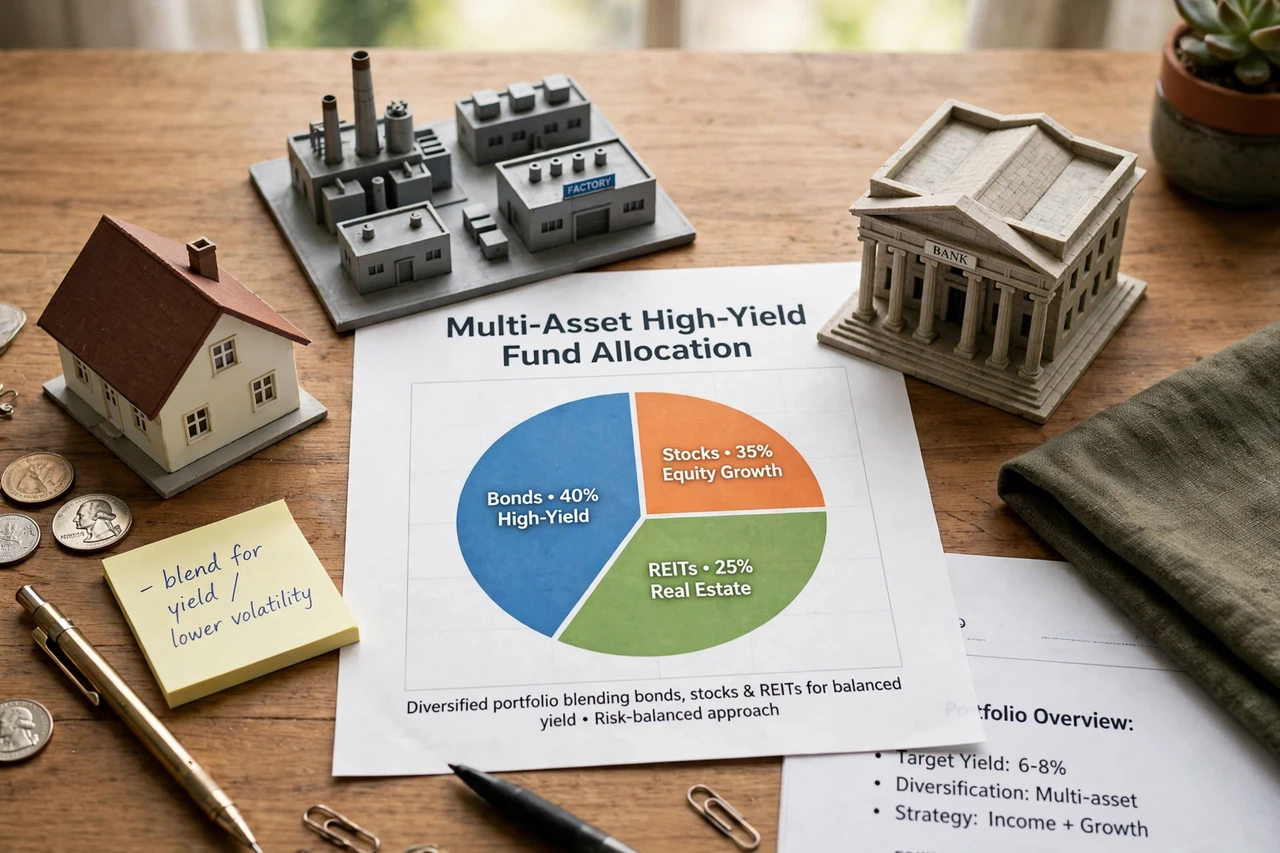
7. Multi-Asset High-Yield Funds That Blend Bonds, Stocks, and REITs
Multi-asset high-yield funds blend bonds, dividend stocks, REITs, and sometimes preferred shares into a single portfolio, aiming to smooth income by drawing from several sources at once. Blending can help, because different assets struggle at different times, but it can also hide concentration if the fund’s manager shifts heavily into whichever asset currently pays most. Transparency matters more here than in single-asset funds.
Read the fund’s current allocation, its allocation limits, and how that allocation changed over the past few years. A fund that drifts dramatically toward one asset class may no longer match the balanced profile you researched. Multi-asset funds can simplify income investing, but only if you monitor what is actually inside them.
8. Reading a High-Yield Fund’s Distribution Coverage Before Investing
Distribution coverage asks a simple question: does the fund earn enough from dividends, interest, and other income to support the payouts it sends to investors? When coverage falls short over a long period, the fund may be returning capital, using leverage, or drawing on reserves to maintain an unsustainable payout. A single covered month proves little; a pattern over several years proves much more.
Find coverage information in annual reports, fund fact sheets, and distribution notices, and compare it across similar funds. Be especially cautious with funds whose payouts stayed flat while their earnings fell, because that gap usually closes through a cut or a falling share price. Coverage is one of the most useful checks in high-yield research, and it should come before any decision to invest.

Frequently Asked Questions
Does a higher yield mean a better fund?
No. Higher yields usually signal higher risk, such as weaker credit, concentration, leverage, or unsustainable payouts. Compare funds by holdings, coverage, fees, and history first, and treat yield as one data point among many, not as a ranking.
Can high-yield funds cut their payouts?
Yes. Funds can reduce distributions when holdings cut dividends, borrowers default, or market conditions change. No fund guarantees its payout, and a fund that maintained payouts through past stress still deserves fresh research before you rely on it.
Are high-yield funds suitable for retirement income?
They can be part of a retirement income plan, but rarely as the whole plan. Retirees often pair them with steadier holdings, cash reserves, and diversified funds, so a payout cut in one category does not disrupt essential spending. Personal circumstances and risk tolerance should guide the mix.
How do taxes work for high-yield fund distributions?
Tax treatment varies by source: bond interest, stock dividends, REIT income, and return of capital are taxed differently, and municipal bond interest may be tax-exempt. Check each fund’s tax documents and consider account placement, such as holding tax-inefficient funds in retirement accounts where appropriate.
What is the first check I should run on any high-yield fund?
Start with the prospectus: holdings, strategy, fees, leverage, and distribution history. Then check distribution coverage and past performance during a downturn. If you cannot explain where the yield comes from in plain language, keep researching before investing anything.